

Back in 2015, an incident we now call the Rough Fire happened due to a lightning strike.
The fire torched over 150,000 acres of forest west of Kings Canyon National Park.
It swept through seven sequoia groves in Sequoia National Forest. Moreover, it also affected the General Grant Complex in Kings Canyon National Park.
Once the smoke cleared and the flames calmed, the devastation came into light. 27 big sequoias in the park and 74 in the national forest perished.
It was an unusually high number of losses. Experts did not see that coming, and they thought that this was alerting.
According to Ben Blom, director of stewardship and restoration for the Save the Redwoods League, “The idea of immortal sequoias no longer seemed to be true.”
It was particularly worse in 2020 and 2021. In those years, tens of thousands of giant trees faced an existential crisis due to climate change.
Record-breaking heat, drought, bugs, and intense fires in California put the sequoias into a tough spot.
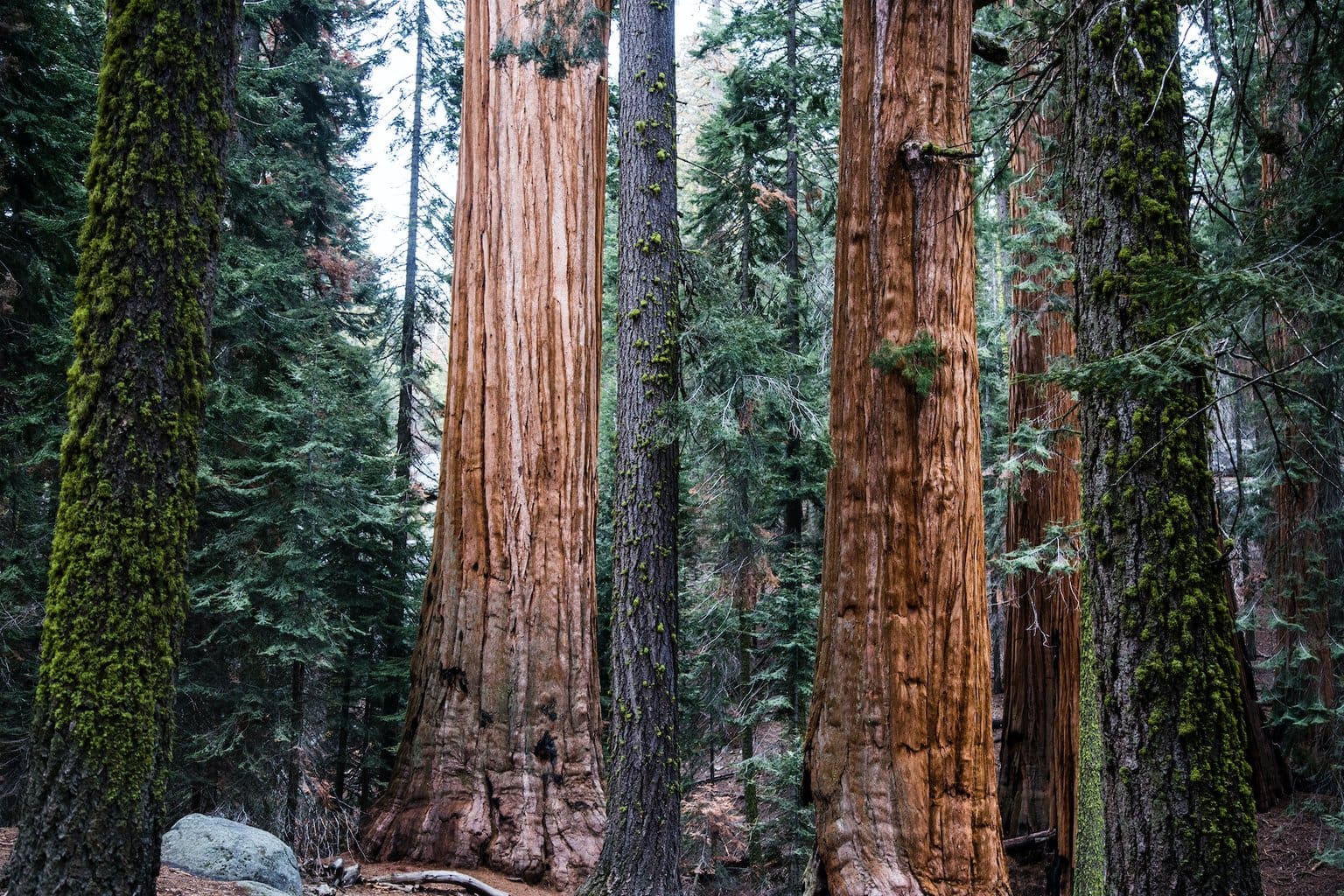
Giant sequoias are the largest trees on the planet by volume. These trees are exclusive to California, standing tall in 80 groves along the Sierra Nevada mountains.
While coast redwoods are generally taller, sequoias were long considered indestructible. Compared to the former, they have flame-resistant bark and adaptability to wildfires.
Times have changed, unfortunately. Bark beetles and drought have killed off other trees in the sequoias’ neighborhoods.
Moreover, there was also lack of Indigenous people’s “good fire” practices. Combined with a century of suppressing wildfires, and changing climate conditions, crisis rose.
This set the stage for disastrous fires in 2020 and 2021.

Keeping the risks to a minimum
To address the urgent issue, experts have gotten busy saving the remaining giants.
Biologists, Native American tribes, and government teams have thinned out overgrown woodlands around these majestic trees and done controlled burns.
The large-scale efforts started in 2022.
Why the burning and cutting, you ask? Well, experts believe that these efforts help prevent super-hot fires from reaching the sequoia canopy.
Aside from reducing fire risk, those acts make more water available to surviving trees. And in turn, they can boost their resilience.
However, such management, including heavy-duty logging, has stirred up some controversy.
A bipartisan Congressional bill aiming to fund sequoia thinning efforts is facing challenges from conservation groups.
The bill is called Save Our Sequoias, which has been introduced.
Conservation groups, however, argue that the legislation lacks proper environmental review. They have concerns about potential environmental damage.
This back-and-forth is getting more heated nowadays. It’s partly due to the Biden Administration commits $50 billion over a decade to reduce fuel loads in Western states.
Advocates stress the urgency. They emphasized that without action, these cherished forests could turn into shrublands due to repeated high-severity fires.
The focus to saving sequoias
In the future, the plan is to have more indigenous people take part in the effort. For instance, the Tule River Indian Tribe will be more active to preserve the trees.
Tribes like the Tule River Indian Tribe have been managing sequoia groves for years. It’s only wise to invite them back into sequoia management.
Then, there’s a plan to reintroduce beavers to help keep water in the meadows near the groves.
Foresters are also studying the best ways to replant trees in burned areas, testing which genomes will thrive in future conditions.
Joanna Nelson from Save the Redwoods League said, “We need to do everything we know how to do.
“We need limits on greenhouse gas emissions, and we also need active management to have giant sequoias around.”
Other tribes’ effort to save centuries-old trees
In Haida Gwaii, the Indigenous Peoples’ home in British Columbia, massive red cedars have an important role.
The people peel the trees’ bark from time to time to make traditional baskets. But, they do it carefully and sustainably—only taking what they need.
In the current days, most of these giants are gone. The irony is, these cedars can live a millennium and tower nearly 200 feet.
The people are now fighting to save the cedars that give life to spiritual and artistic traditions.
Haida native Lisa White-Kuuyang has tried blocking logging operations, created videos, and made social media campaigns.
Lisa actively advocated for her people, ancestors, and future generations.
Ancient cedars
Haida Gwaii has centuries-old cedars that are valuable—at over $20,000 each as lumber. But they’re facing rapid depletion.
According to the University of British Columbia, over 2,000 hectares of Haida forests are deforested annually.
Lisa’s family now has to travel for hours. It’s not easy to find old-growth cedars that are healthy enough to harvest.
For the longest time, Haida people have harvested the cedars for totem poles, canoes, bentwood boxes, masks, and weaving.
In particular, Lisa’s family are artists that depend on the cedars, with their work exhibited in Canadian and U.S. museums.
Despite working with tradition daily, however, Lisa says the family has lamented the vanishing Haida “trees of life.”
The land’s devastation is intertwined with the people’s trauma. Lisa has made this a daily reminder when observing the transportation of cedar logs to lumber-consuming places.
According to an artist from Lisa’s family, trees suitable for totems and canoes must be really old.
For instance, the cedar for a recent totem was six feet in diameter and 800 years old.
With the alarming rate of old-growth cedar depletion, concerns grow. One of which was about finding such ancient specimens for future work.

Old-growth cedars and the life they give
The Haida have not remained silent amidst the devastation.
In 1985, many were arrested during the Lyell Island anti-logging blockade. This sparked Indigenous rights movements, which led to the creation of Gwaii Haanas National Park and Reserve in 1993.
But since 2012, the British Columbia government has collaborated with the Haida Nation.
It has limited annual logging to 800,000 cubic meters, a third of the level 30 years ago. However, that was not enough to prevent more ancient trees deforestation.
Although nearly half of Haida Gwaii is protected, logging is getting near protected areas, degrading ecological integrity.
Tensions arise as some Haida see forestry as essential to their economy, leading to conflicting views among residents.
Deforestation near watersheds spawning salmon is affecting stocks, the primary food source for the Haida.
And to make things worse, wildlife like bears and deer are forced out of their habitats. They’re entering villages, pushing more wildlife-human conflict.
Conservationists believe that forestry subsidies, averaging $1 million daily more than stumpage fees and taxes, can help. They could potentially be better used for environmentally friendly employment in Haida Gwaii.
Additionally, experts suggest making Haida a UNESCO Biosphere Protected Area Reserve. This will benefit the Haida through tourism, providing employment while protecting forests.
In 2021, Lisa proposed the creation of an Indigenous Protected and Conservation area. This aims to safeguard areas close to most Haida people. Her proposal, however, still awaits action.
Nonetheless, the Haida doesn’t relent on trying to save the ancient cedars.
“We are the cedar people. It’s about time we got our rights back so we can carry on with our culture,” one of Lisa’s family said.
Sources
Leave a Reply