


The spotted lanternfly has wreaked havoc on New Jersey’s local agriculture for years. Selina Zhang first found this invasive species as a young student visiting a market near her hometown, Annandale.
At first, she was intrigued and attracted by the vibrant colors of the moth-like bugs. Soon, however, she realized the damage they caused.
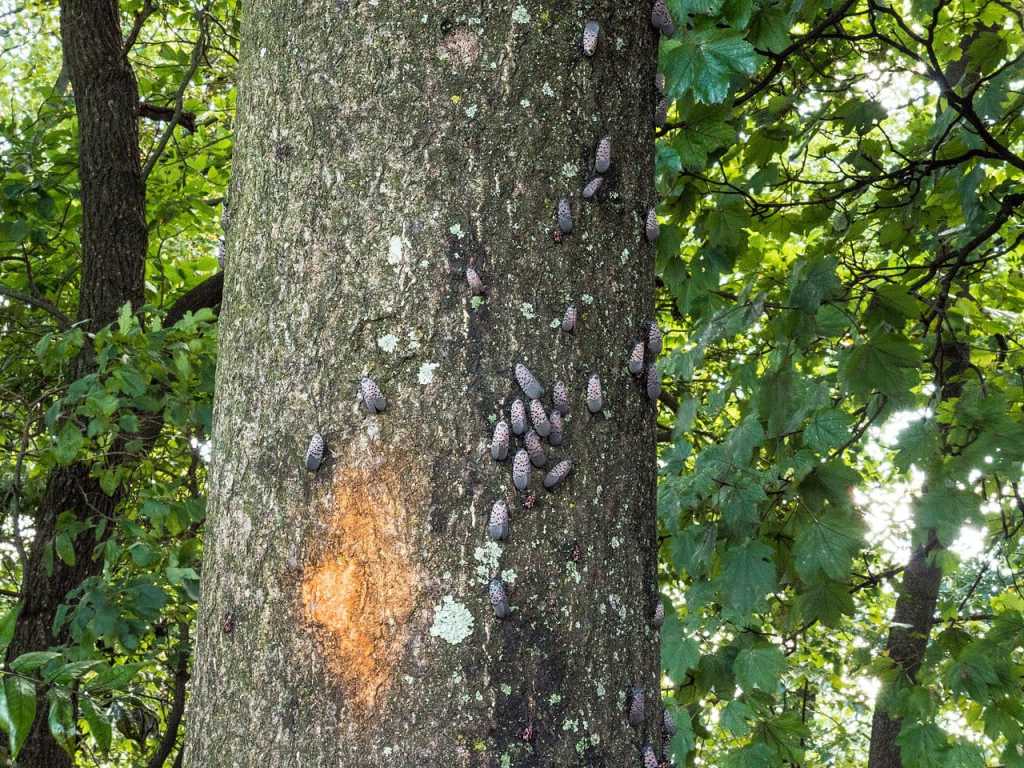
These invasive bugs are in the category of plant-hoppers. They hop from one plant to another to feed on their sap, affecting over 70 species.
This feeding behavior stresses the plants, making them more vulnerable against diseases and other attacks.

Moreover, the insect secretes a substance called honeydew. It’s a sticky waste that accumulates on trees, hindering photosynthesis and promoting the growth of mold.
Endemic to China, the moth-like bug likely arrived in the US on a stone shipment in 2012 as egg masses.
In 2014, a group of these pests was discovered in Berks County, Pennsylvania. It marked the beginning of their invasion across 17 states.
Zhang stated that as she grew older, she felt the need to act. She wanted to develop an innovation that combined her personal perspective and existing research to target the bug.
The current methods of managing these bugs involve insecticides and sticky bands. Both have harmful side effects on the environment.
Insecticides leave toxic residues harmful to pollinators like honeybees. Sticky bands, on the other hand, can unintentionally trap birds and other animals.
Unlikely inspiration
To address the lanternfly issues, Zhang drew inspiration from chess boards and “Dance Dance Revolution,” the dance game one can find in game arcades.
After weeks of field observation, algorithmic programming, and utilizing an umbrella from her family’s patio, she created ArTreeficial.
It’s a solar-powered, self-cleaning, AI-driven “tree” that lures the spotted lanternfly and eliminates it using an electronic mesh.
Zhang explained that ArTreeficial was like a supersized mousetrap for combating the pests.
The bait here is the main component of the bugs’ main choice of plant in their homeland, the tree of heaven.

Other than thoroughly reviewing literature, Zhang spent weeks observing the spotted lanternfly in its natural habitat.
She documented its behavior and characteristics and took 500 photos of the insects. Basically, Zhang was creating a personal database to understand their habits better.
Zhang emphasized that the key was to have a deeper understanding of the ‘enemy.’ Without knowing how they behave, Zhang said, it was impossible to create an effective trap.
The young New Jersey native had a clear vision. She wanted to make a tree-like structure resembling the tree of heaven.
So, she grabbed an umbrella from her family’s patio and got started.

Fake, bug-zapping, AI-driven tree
First, Zhang used ultrasound to release a scent similar to the tree of heaven from ArTreeficial’s trunk to lure the pests.
Then, she made an electric net for the artificial tree, which would zap spotted lanternflies when they landed on it.
At first, Zhang wrapped a charged net around the trunk. This led her to two issues.
First, the net posed a safety risk, because there was no protective barrier for the electricity. Second, agile individuals could potentially avoid the single net.
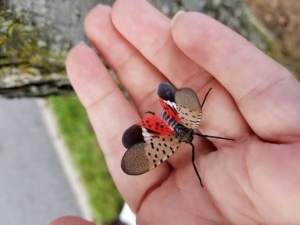
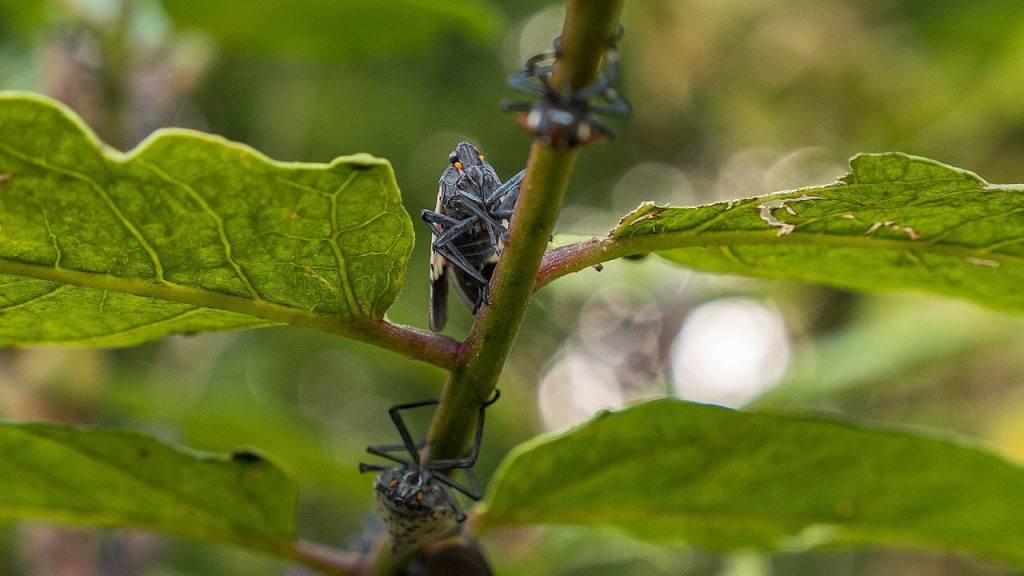
Reflecting on her observations in the field, Zhang remembered that the pests took long, careful steps. They often stretch out their legs, sometimes wiggling them in the air before placing them down.
Keeping this in mind, Zhang upgraded to a double-layered net. It covered ArTreeficial with a large outer net and a tighter inner mesh.
This setup would allow the outer layer to act as a safety guard. It would also enable the spotted lanternfly to step through the small holes in the upper mesh. Eventually, they would come into contact with the inner mesh.
Similar to a chess board, Zhang’s nets are divided into multiple squares running up and down the structure.
Basically, when a spotted lanternfly steps on the inner net, the A.I. model kicks in. Electricity flows through that part while the rest stays inactive, and the insect gets zapped.
Then came the AI. Zhang used her collection of photos to teach and program her A.I. model.
Zhang didn’t just want to rely on internet pictures as they often show just specific parts of the bug.
Looking forward
Good data is essential to training a good AI model. Zhang believes that her field observations and photos give the model a better understanding of the pest.
Zhang plans to take more photos of spotted lanternflies in the spring, when they start hatching.
This is to better train her A.I. model to recognize the pest at all stages of growth.
Another little challenge that needs addressing is that catching spotted lanternflies isn’t easy. They’re quite good at avoiding traps.
So, Zhang wants to see if using essence from dead spotted lanternflies can improve her lure and test her invention in the field.
Looking ahead, she also hopes to patent her product.
Currently, ArTreeficial costs about $200 to make. Zhang has talked to local farmers, and she hopes to lower costs over time through mass production and partnerships with local companies.
And once she proves her system works with spotted lanternflies, Zhang wants to use it for other invasive species too.
Other than developing ArTreeficial, Zhang plans to spread awareness of this pest through her talent as an artist and writer.
She has turned spotted lanternfly into a villainous comic book character.
“Wherever it goes, it causes havoc. With my comics, I wanted to help people understand this local invasive species and its behavior,” Zhang said.
Let’s all hope for the best for Selina Zhang and her journey to help getting rid of the pests.
Let’s also remember that there are other ongoing efforts to help control spotted lanternfly populations. For instance, training pooches to be the pests’ “hunter.”
Dog soldiers employed to fight spotted lanternflies

In Indiana, dogs are being trained to help fight against the pests.
Kallie Bontrager leans in close to Que, her 11-year-old Australian shepherd.
She commanded Que to find the bugs. The pooch used his keen nose to track down the eggs of the spotted lanternfly, which in the state, has become a real threat.
Bontrager, along with Que and Epic, are part of the Indiana Department of Natural Resources’ (DNR) team fighting to eliminate this pest.
Bontrager said, “I’ll have the dogs search the perimeter. When they get tired, I’ll take them back and then I’ll help with scraping off the eggs”
Bontrager works as a nursery inspector for the DNR.
After the lanternflies appeared, Bontrager got approval from her DNR supervisors to train her dogs to detect spotted lanternfly eggs.
“With a lot of trial and error, along with help from friends and others experienced in training detection dogs, we’ve managed to get it so that I’m pretty confident in their abilities,” Bontrager said.
The first reported sighting of these pests in Indiana was in 2021 in Switzerland County.
A year later, they were found in Huntington. Since then, they’ve spread to St. Joseph, Elkhart, and Porter counties.
The infestation is particularly severe in Huntington.
During a recent mission, Epic, a six-year-old Australian shepherd, found the first egg sac. It was on a tree branch as the team was walking to the warehouse area.
“They like to hide their egg masses so that they’re protected and predators can’t find them,” explained Vince Burkle, assistant director of the DNR’s Division of Entomology and Plant Pathology.
Each gray egg sac contains 30 to 50 lanternfly eggs. One can easily destroy it with a putty knife or scraper.
Burkle simply uses his thumb to squash them.
“You just kind of smash them, and you can see all the goo come out,” Burkle said, running his gloved hand over a line of egg sacs on a fallen tree limb.
With the help of Que and Epic, the DNR destroyed over 3,000 lanternfly egg sacs in a recent outing at a single site in Huntington. Both helped destroy over 14,000 for the year.
Burkle said, “When you consider an average of 40 eggs in each sac, that’s a significant number of spotted lanternflies that won’t hatch come May. So, that’s a positive outcome.”
Sources:
Leave a Reply