

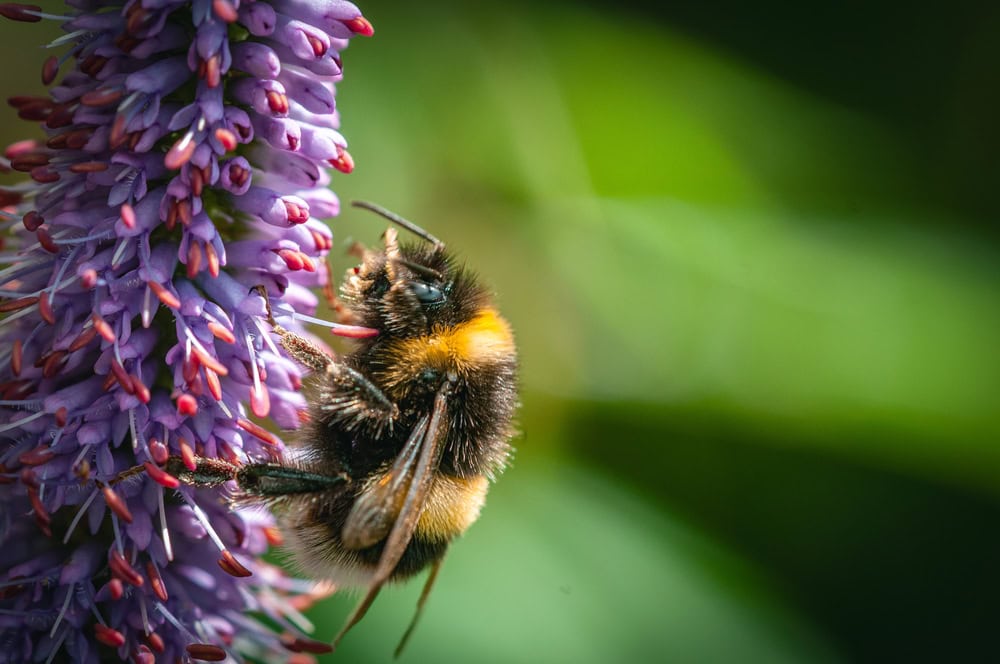
Researchers from the University of Guelph discovered new findings about the health, survival, and reproduction of bumblebees.
Dr Nigel Raine and Dr Sabrina Rondeau from the university’s environmental sciences department found that bumblebee queens are more likely to hibernate in pesticide-contaminated soil rather than clean soil.
This is something they’ve yet to understand. Dr Raine says, “Some bee behaviors remain poorly understood. We wanted to determine whether bumblebee queens exhibit avoidance behaviors to reduce their pesticide exposure in the field. However, our findings were quite alarming.”
In the research, the authors conducted field experiments with newly emerged queens of the common eastern bumblebee (Bombus impatiens).

They allowed the queens to fly, mate, and choose a hibernation site for the winter–all freely within outdoor enclosures.
The scientists presented these queens with two options: clean or contaminated soil. The latter means soil contaminated with one of the five commonly used pesticides, including insecticides and fungicides, at various concentrations.
After carefully examining the soils for hibernating queens, the researchers discovered that the bees were twice as likely to select pesticide-contaminated soil over pesticide-free soil.
Surprisingly, most bees survived the study. However, the researchers noted the potential long-term impacts on colonies.
Raine says, “This raises serious concerns for bumblebee health, especially as these critical insect pollinators are already facing numerous challenges.”
Bumblebee queens typically hibernate underground during winter, emerging in spring to establish new colonies. Both Raine and Rondeau wanted to explore how exposure to soil contaminants during this vulnerable life stage might affect their behavior and survival.
Previous studies have shown that pesticides can either attract or repel bees depending on the type, environmental context, and concentration.
At first, the team hypothesized that queens would avoid pesticide residues in soil. As we know, it turned out differently.

“We did not anticipate this outcome. It suggests that queens might actually prefer contaminated soil, though the reasons remain unclear,” Rondeau says.
Possible Explanations
According to the researchers’ speculation, pesticides may alter soil properties, making it more appealing to queens. For example, fungicides might eliminate soil fungi and nematodes, which queens could instinctively avoid during hibernation.
Another theory is that queens may develop an “acquired taste” for pesticides due to previous exposure in their environment.
Or, their preference could stem from novelty-seeking behavior, a trait often observed in bees that helps colonies discover new resources.
Other additional questions about the research follow, such as whether bumblebee queens would exhibit similar behavior in larger, real-world environments.
In such environments, natural scents and field characteristics might influence their choices. Furthermore, it remains unclear whether these findings apply to other bee species.
Due to this uncertainty, more research is needed to fully understand the mechanisms behind this behaviour.
These findings, however, underline the need for a reassessment of pesticide use and management practices. Because as we know, pesticides are a significant contributor to the global decline of insects.
Other than being potentially fatal, they can impair bees’ movements and hinder their ability to gather nectar and pollen. This poses risks to ecosystems as well as food systems worldwide.
More assessment on pesticide risk
Typically, pesticide risk assessments overlook soil as a critical route of exposure for bees. Therefore, the researchers urge improvements in such assessments to grasp the newly observed behaviour.
Rondeau says, “As we move forward, it’s vital to examine how agricultural practices—such as pesticide types, application methods, and vegetation management—affect pesticide residue accumulation in soils where queens are likely to hibernate.
_-_Guelph,_Ontario.jpg)
“By gaining a deeper understanding of how pesticide residues interact with soils and impact bees, we can develop strategies to safeguard these essential pollinators.”
If the University of Guelph study highlights the preference of bumblebee queens on pesticide-contaminated soil, another similar study by scientists at Julius-Maximilians-Universität Würzburg (JMU) finds the species’ tolerance to pesticide mixtures.
Bumblebees showing resilience to chemical stressors
Published in the journal Environment International, the research examined how bumblebees respond to exposure to individual pesticides as well as combinations of insecticides and fungicides.
And just as the previous research, the authors were surprised upon finding that there were no adverse effects on the insect’s learning ability or flight activity.
For this study, the JMU researchers collaborated with ones at the University of Bayreuth. The experiment involved dividing a bumblebee colony into groups and exposing them to various pesticide treatments.
First author Antonia Schuhmann explains, “The experiments show that bumblebees appear resilient to chemical stressors such as pesticides.”

In comparison to honeybees, wild bees don’t have the protection of beekeepers. Other than the fact that they face more risks, not many have studied them as extensively as honeybees.
“In nature, bees are rarely exposed to a single stressor but encounter a variety of factors that can harm pollinators. Pesticide use is among the leading causes of insect decline,” explains lead author Professor Ricarda Scheiner.
Bumblebees and all wild bees are frequently exposed to a range of pesticides during foraging. They often bring these chemicals into their colonies through collected food.
According to Schuhmann, “The ingestion of pesticide mixtures can lead to behavioral effects that are hard to predict. Some substances may interact to amplify or diminish their impacts.”
Studying bumblebees and pesticide
To explore how pesticide mixtures influence bumblebee behavior, the researchers developed a new experimental setup.
They divided a single bumblebee colony into four compartments. Here, they put multiple treatment conditions like insecticides, fungicides, and combinations—within the same colony.
Scheiner says, “This method minimizes variability between colonies and reduces the number of colonies required for experiments.”
The team then examined the bees’ learning behavior by training them to associate specific flower colors with a sugar water reward in a controlled flight arena.
Afterwards, the researchers tested the bees to see if they could accurately identify the trained color.

The results showed that pesticide treatments, whether individual or mixed, did not impair the bees’ ability to learn.
A technology called RFID was used to monitor the bees’ flight activity.
Tiny tags were attached to individual bees, each carrying a unique ID. Scanners placed near the colony entrance recorded the bees’ movements with time stamps, enabling precise tracking of flight activity.
Once more, the team found no differences in flight behavior between treated and untreated groups.
Cause of resilience
According to the researchers, one reason for bumblebee’s resilience may be due to their social lifestyle.
“Living in colonies allows bumblebees to buffer toxic effects, ensuring the survival of weaker individuals,” Scheiner explains.
In addition, bumblebees are larger than many solitary wild bees, which may make them less vulnerable to certain stressors.
What does this mean for smaller wild bee species then?
It’s still unclear, because as mentioned, we haven’t studied wild bees as thoroughly as honeybees. We still don’t know whether other wild bee species would show similar resilience.
Smaller, solitary bees may react differently to pesticide mixtures–this makes further research crucial to understand and preserve wild bees.
Like in the first study, the researchers call for additional studies so we can have a better understanding of the effects of pesticides, not just on bumblebees but also on a broader range of wild bee species.
On one hand, I’m somewhat relieved that bumblebees can adapt to harsher environments and hope they can thrive so we’ll see more of them.
Just a little FYI, scientists have also recorded queen bumblebees surviving underwater–yet another proof of their resilience, and my love for them grows even more.
At the same time, however, I’m also a little bit wary of pesticides’ effects on them in the long run. Will they change the bees’ cycle? Will they negatively affect the way the environment works?
There are still so many questions and I hope that more researchers will study more wild bees and not just bumblebees. But what do you think of this discovery?
Sources
https://phys.org/news/2024-10-bumblebee-queens-hibernate-pesticide-contaminated.html
https://phys.org/news/2024-04-bumblebees-dont-pesticide-cocktails-highlights.html
Leave a Reply