

There has probably never been a better time than in today’s eco-conscious market to start building a green brand. It’s good for the planet and good for business. Today’s consumers are growing ever more conscious of their ecological footprint and looking to affiliate with companies that share their values.
Creating a growing exceptional chance to differentiate, and access this growing market of environmentally conscious customers. How does one build a brand that is resilient, sustainable, and speaks to the modern consumer who is more in tune with environmental issues?
Building a green brand requires a strategic approach that integrates sustainability into every facet of your business.
By setting clear, measurable sustainability goals and investing in eco-friendly product innovation, businesses can align their values with consumer expectations, driving both brand loyalty and revenue.
Using sustainable packaging solutions and implementing efficient manufacturing practices further reduces environmental impact, demonstrating a genuine commitment to sustainability.
For businesses looking to expand or bring innovative eco-friendly practices to the U.S., a well-crafted eb2 niw visa business plan can be instrumental in facilitating their growth while ensuring they adhere to green principles.
By adopting these strategies, companies not only enhance their market position but also contribute to a more sustainable future.
1. Establish Clear Sustainability Goals

The primary prerequisite of every green brand is a set of measurable goals in the sphere of sustainability. These objectives should be:
Specific: Waldman’s suggestion was to define exactly what you want to achieve:
Measurable: Make measurable goals that will help in checking the level of implementation.
Achievable: It is recommended that the set goals should be measured by the capacity you already possess.
Relevant: Ensure that the strategic objectives relate to your company’s mission and embrace the organizational values.
Time-bound: Make particular goals to set timelines to get the work done as soon as possible.
If communicated effectively to the employees and your customers, you will have a positive impact on your customers hence creating a trusting relationship to the company’s sustainability goals.
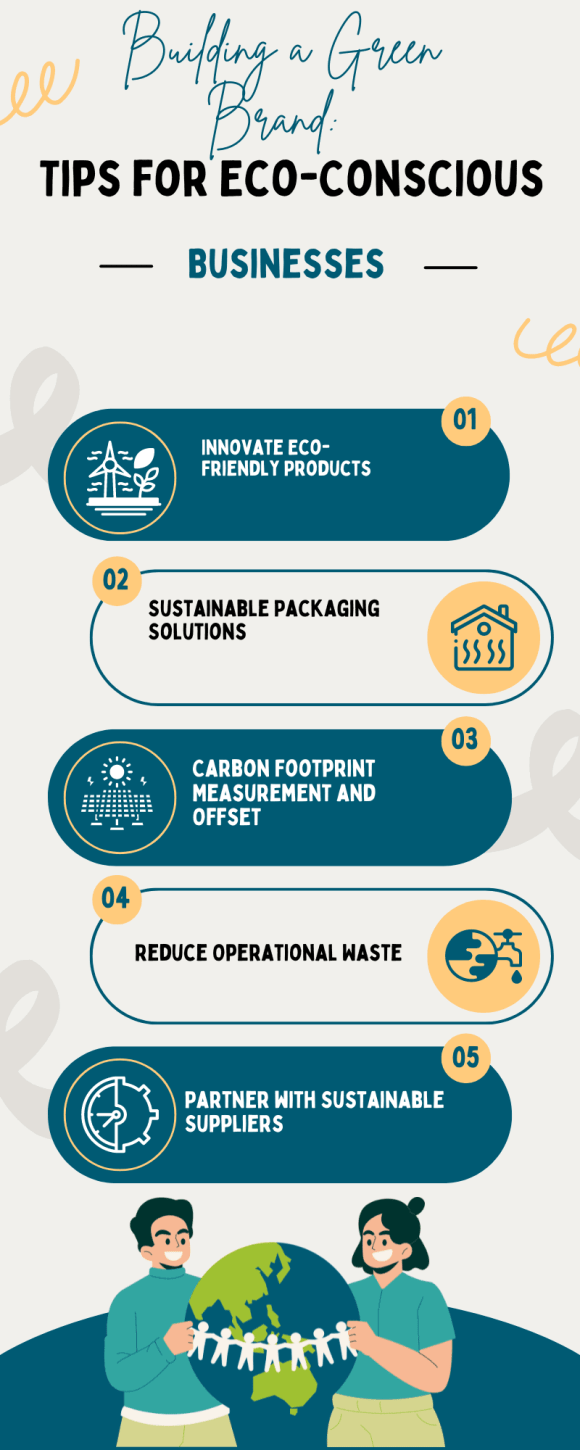
2. Innovate Eco-Friendly Products
Subsequently, after setting the goals, the next step is to implement them via the introduction of products. Thus, one of the strategies for achieving sustainable competitive advantage and winning the hearts of green consumers is by designing green products.
Consider these approaches:
- Employ recycled or biodegradable materials in your products
- Design for life to minimize excess development for the landfill.
- Adopt a circular economy in the design and management of the life cycle of your product
Industry Leader Spotlight: Patagonia is one of the Industry Leaders in climate change solutions and the company’s innovation in products that have gone green is an excellent example. Most of their products are made from recycled materials and they have an efficient repair and reuse policy to increase product use.
3. Sustainable Packaging Solutions

Sustainability is not limited to the product; the packaging also has an influence on the company’s sustainability index. Consider these sustainable packaging options:
- Recyclable materials
- Biodegradable packaging
- Reusable containers
Environmentally friendly packaging is sustainable, so when you incorporate it you are not only saving the environment but also appealing to environmentally conscious customers. According to the survey, the majority of consumers are willing to pay a higher price for products with environmentally sensitive packaging.
For instance, the Toronto Green Standard provides a set of performance measures for sustainable site and building design. It applies to new private and public developments to improve air and water quality, reduce greenhouse gas emissions, and enhance urban biodiversity.
4. Reduce Operational Waste
Sustainability cannot be viewed in terms of the products that you offer – it is crucial for the overall management of the company. The efficient practice of manufacturing not only has direct monetary benefits which are saved but also cuts on the expenses incurred by causing harm to the environment.
Consider these strategies:
- Optimize your production processes to minimize waste
- Implement energy-efficient technologies
- Adopt a circular economy approach in your operations
5. Partner with Sustainable Suppliers

As said in the previous section, the sustainability of your brand goes beyond the facilities you operate. Due to the affiliation with suppliers willing to integrate sustainable practices, one can guarantee the sustainability of the entire supply chain.
Here’s how to approach sustainable supplier partnerships:
- Evaluate current suppliers: Assess their sustainability practices and commitments.
- Set standards: Establish clear sustainability requirements for your suppliers.
- Collaborate: Work with suppliers to improve sustainability practices together.
- Regular audits: Conduct periodic checks to ensure compliance with your standards.
This helps build trust and connect with like-minded suppliers, enhances the manufacturer’s image, and promotes sustainable development in your industry.
6. Engage and Educate Your Audience
Building a green brand isn’t just about what you do—it’s about how you communicate it. Engaging and educating your audience about your sustainability efforts is crucial for building brand loyalty and attracting eco-conscious consumers.
Try these engagement strategies:
- Transparent communication: Share your sustainability journey, including challenges and successes.
- Interactive content:Use webinars, social media, and other platforms to engage with your audience.
- Employee education: Ensure your team understands and can communicate your sustainability efforts.
- Customer education: Provide resources to help customers make more sustainable choices.
7. Carbon Footprint Measurement and Offset

Understanding and addressing your carbon footprint is an important step in building a truly green brand. Here’s how to approach it:
- Measure: Calculate your business’s carbon emissions across all operations.
- Reduce: Implement strategies to minimize your carbon footprint.
- Offset: Invest in carbon offset initiatives to counterbalance unavoidable emissions.
Popular carbon offset projects include:
- Reforestation efforts
- Renewable energy projects
- Methane capture initiatives
By taking concrete steps to address your carbon footprint, you demonstrate your commitment to combating climate change—a key concern for many consumers.
8. Obtain Sustainability Certifications
Sustainability certifications provide third-party validation of your eco-friendly practices, building credibility and trust with consumers. Some popular certifications include:
- Fair Trade
- USDA Organic
- Energy Star
- B Corp Certification
| Certification | Focus Area | Benefits |
| Fair Trade | Ethical sourcing and labor practices | Demonstrates commitment to social responsibility |
| USDA Organic | Organic agricultural practices | Appeals to health and environmentally-conscious consumers |
| Energy Star | Energy efficiency | Highlights commitment to reducing energy consumption |
| B Corp | Overall social and environmental performance | Comprehensive validation of sustainable business practices |
While obtaining these certifications can be rigorous, they provide valuable proof of your commitment to sustainability.
9. Continuous Improvement and Feedback
Building a green brand isn’t about one-off campaign execution, it is more nuanced and continuous. To be in a leading position in this continuum: Seek feedback: Obtain regular customer and stakeholder feedback on what one is doing regarding sustainability.
Keep abreast: Continuously update oneself on the changing trends and technologies in sustainability relevant to your industry.
Iterate: Rework and refine continuously, by use of the feedback and new information. Report progress: Share updates periodically about your goals and achievements in sustainability.
It’s when you show a commitment to continuous improvement that you are hardwiring the concept of sustainability into your brand—not some clever marketing technique.
Conclusion
In establishing a green brand, it needs to be comprehensive such that it involves all parts of the establishment. From setting objectives for environmentally friendly products to communicating with like-minded customers, each stage is essential in branding a sustainable business.
Sustainability does not just mean eco-friendliness; it is also the act of establishing a future business that is flexible and compliant with modern consumers’ ethics. You, in essence, are being friendly to your planet while highly positioning your brand in an environmentally rigorous market for the future.
FAQs
Q1: How can a company avoid greenwashing in sustainability marketing?
To avoid greenwashing, companies should be transparent about their activities and challenges in the area of sustainability, base all their claims on what has to be hard and verifiable data, seek third-party certifications to back up their intentions, focus on meaningful, substantial initiatives instead of surface changes, and, of course, be sure to teach the audience about the complexity of sustainability.
Q2: What are some effective strategies for small businesses to build a green brand?
Small businesses can establish a green brand by setting explicit and achievable sustainability goals and using eco-friendly raw materials in their products and packaging. Engaging the community at the local level in environmental efforts, together with customer education, shall uphold the credibility of such efforts. Certifications will further validate them. Partnering with other local, sustainable businesses creates a collaborative network of like-minded, eco-friendly peers.
Q3: How can companies measure the effectiveness of their sustainability efforts?
Businesses can assess how effective they are in sustaining themselves by examining key performance indicators (KPIs) that match their goals including declines in the amounts of carbon emissions, energy used, and waste generated. Additionally, gauging consumer perceptions with questionnaires, studying fluctuations in sales or customer loyalty due to green initiatives, and appraising changes to supply chains offer significant clues. Moreover, progress made towards attaining sustainability certifications is an important measure too.
Leave a Reply