

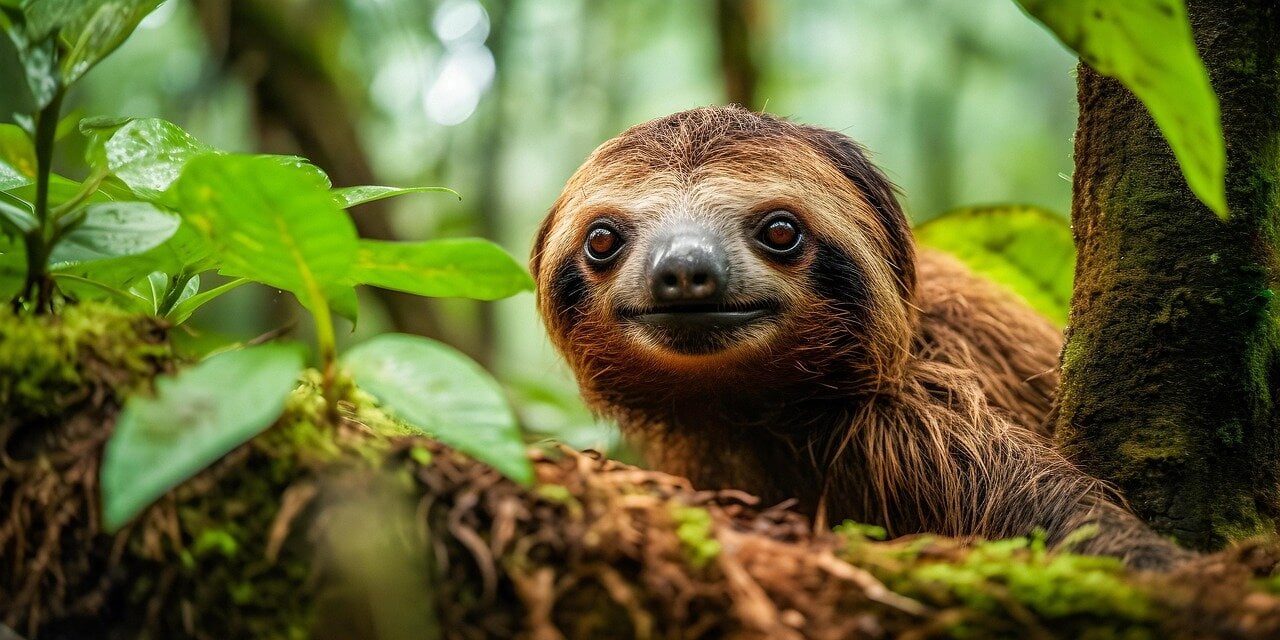
Every year on October 20, people around the world celebrate International Sloth Day, a lesser-known observance dedicated to raising awareness about one of the planet’s most unusual and misunderstood animals.
Established in 2010 by the Colombian animal welfare organization AIUNAU, the day is meant not just to admire sloths for their slow-motion charm, but to spotlight the serious conservation challenges they face.
Sloths have become internet icons, symbols of calm in a fast-paced world. Yet behind their relaxed expressions lies a sobering reality: several sloth species are endangered, and their survival is increasingly threatened by human activity.
Let’s talk about this animal that live in slow motion, yet it doesn’t mean that they are less important than faster animals.
More Than Just “Slow Animals”

Sloths belong to an ancient mammalian lineage and are divided into six extant species, grouped into two-toed sloths (Choloepus) and three-toed sloths (Bradypus). While the difference in toe number seems minor, it reflects deeper evolutionary and behavioral distinctions.
Two-toed sloths are generally larger, more active, and more adaptable to a range of habitats. Three-toed sloths, on the other hand, are more specialized, slower-moving, and limited to smaller rainforest ranges.
This specialization makes them particularly vulnerable to environmental change. Historically, sloths were not always small and arboreal. Extinct giant ground sloths once roamed the Americas, reaching lengths of over three meters and weighing more than a metric ton.
Their disappearance thousands of years ago highlights how sensitive sloths are to ecological disruption, a warning that resonates today.
Sloths Habitat
Modern sloths are native exclusively to the tropical rainforests of Central and South America, where they spend nearly their entire lives in the forest canopy. These dense, interconnected treetops provide food, shelter, camouflage, and protection from predators.
Rainforests are not just homes for sloths; they are highly specialized environments that sloths have evolved to depend on.
Fragmentation of these forests, through logging, agriculture, or urban expansion, forces sloths to descend to the ground, where they are slow, vulnerable, and far more likely to be injured or killed.
Not all sloths face the same level of risk, but some are in critical danger. The pygmy three-toed sloth, found only on the tiny Isla Escudo de Veraguas off the coast of Panama, is classified as Critically Endangered by the International Union for Conservation of Nature (IUCN).
With a population estimated at only a few hundred individuals, it is among the most endangered mammals on Earth.
The maned three-toed sloth, native to Brazil’s Atlantic Forest, is listed as Endangered. This forest has already lost over 85% of its original coverage, leaving the species increasingly isolated.
A Lifestyle Built Around Leaves

Sloths are famous for their slow movement, but this trait is not laziness, it is a survival strategy. Their diet consists almost entirely of leaves, which are low in calories and difficult to digest. To conserve energy, sloths move slowly, sleep extensively, and limit unnecessary activity.
On average, sloths sleep 15 to 20 hours per day and travel only about 36 metres daily. Astonishingly, it can take several days to digest a single leaf, thanks to their multi-chambered stomachs and symbiotic gut bacteria.
This slow digestion also explains why sloths relieve themselves only once or twice a week, a risky behaviour that forces them to descend from trees and exposes them to predators.
Sloths have a lower core body temperature than most mammals, which fluctuates with the surrounding environment. If temperatures drop too low, sloths can become sluggish or immobile, making them sensitive to climate changes.
Their skeletal structure is equally unusual. Sloths spend about 90% of their lives hanging upside down, supported by specialised tendons and muscles that allow them to grip branches without expending energy. Their internal organs are adapted to this inverted lifestyle, preventing pressure on the lungs and diaphragm.
Surprisingly Skilled Swimmers
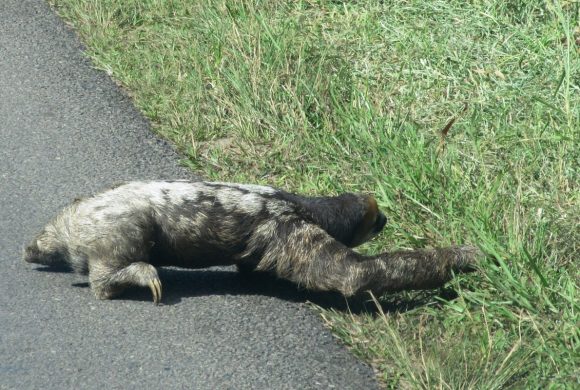
Despite their clumsiness on land, sloths are excellent swimmers. In water, they can move three times faster than on land and hold their breath for up to 40 minutes. Their large, gas-filled stomachs act as flotation devices, allowing them to cross rivers and flooded forest areas with relative ease.
This ability is critical in rainforest environments, where seasonal flooding is common.
In addition to that, one of the most remarkable aspects of sloths is their fur. Unlike most mammals, sloth hair grows away from the body, helping rainwater drain while they hang upside down. The fur also hosts entire miniature ecosystems.
Green algae, particularly Trichophilus welckeri, live in sloth fur, giving them a greenish tint that provides natural camouflage in the treetops. Researchers have found that this algae is passed from mother to offspring, suggesting a co-evolutionary relationship.
In addition to algae, sloth fur shelters beetles, moths, fungi, and microorganisms. Some moth species spend their entire life cycle on sloths, turning these animals into moving biodiversity hubs.
Family Bonds and Early Life

Sloths are solitary animals, but maternal bonds are strong. Baby sloths cling to their mothers for up to six months, learning which leaves are safe to eat and how to navigate the canopy. Even after separating, young sloths often remain near their mothers for two to four years, depending on the species.
This slow development makes sloth populations particularly vulnerable, as they reproduce infrequently and recover slowly from population declines.
Sloths and Deforestation
The most serious threat facing sloths today is habitat loss. Deforestation driven by logging, cattle ranching, palm oil production, and urban expansion destroys the continuous forest canopies sloths rely on.
When trees disappear, sloths are forced to cross roads or open land, where they are often electrocuted on power lines, attacked by dogs, or hit by vehicles. Climate change compounds these threats by altering forest composition and increasing extreme weather events.
Sloths play an important ecological role. By feeding on leaves and moving slowly through the canopy, they help shape forest structure and nutrient cycles. Their fur ecosystems support insects, which in turn affect pollination and decomposition processes.
More broadly, sloths are indicator species. Their decline signals deeper problems within tropical rainforest ecosystems that also threaten countless other species, and ultimately, human well-being.
Sloths have survived millions of years by adapting to a life of patience, efficiency, and balance. Yet their evolutionary strategy is poorly suited to the rapid pace of human-driven environmental change.
Protecting sloths means protecting rainforests, biodiversity, and the intricate ecological networks that sustain life on Earth. International Sloth Day is not just a celebration, it is a reminder that even the quietest creatures deserve attention, respect, and urgent conservation action.
In learning more about sloths, we take the first step toward ensuring that these gentle animals continue hanging in the treetops for generations to come
Leave a Reply