


In the morning, when it’s sunny, Pedro Luis Pérez eagerly checked on hatchlings at his beachside nursery in La Sabana. It’s a coastal town with warm sand, a place where tiny loggerhead sea turtles struggled to break free.
As they struggled, Pérez gently assisted the hatchlings and noted their determination. And who wouldn’t? Such a tiny, lovable creature using its strength to start living in the open seas? I’d be rooting hard for it.
However, success stories like this were rare. Out of a nest of 100 eggs, only 13 survived–a concerning trend in La Sabana.
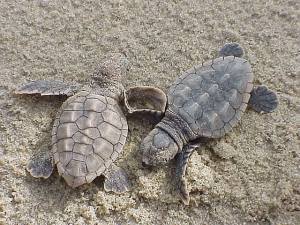
In this region, sea turtles face a dire situation. In La Sabana only, four of the seven sea turtle species on Earth frequent this area. But many species like the critically endangered hawksbill sea turtles, face an uncertain future.
Threats such as coastal development, fishing equipment entanglement, and pollution endanger their survival.
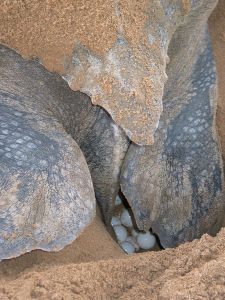
Each spring, adult sea turtles return to La Sabana to lay eggs. Of course, that draws attention from animal lovers and conservationists like Pérez.
Knowing this, Pérez and local volunteers have dedicated years to protecting these hatchlings. Unfortunately, recent seasons have seen a concerning decline in survival rates.
Pérez documents each hatchling’s progress. Despite his efforts, the reasons behind the decreasing survival rates remain elusive. As Pérez and his team waited for more assistance in their conservation efforts, saving these turtles became more urgent.

As it turned out, a similar crisis happening over 300 miles away held clues to understanding and addressing the issue.
Researchers studying turtles at Parguito Beach on Venezuela’s Isla Margarita also happened to notice a decline in survival rates.
Angélica Burgos, a biology student and volunteer with the Nueva Esparta State Sea Turtle Conservation Group, identified a problem in the area back in 2014.
In that year, she noticed the presence of an introduced plant, Scaevola sericea. It’s also known as beach cabbage or sea lettuce which was thriving in the area’s mangrove swamps.
Despite the harmless-sounding name, investigations revealed that the roots of this plant were crowding out turtle eggs, hindering their development.
Burgos observed that in some nests, the roots occupied up to 80% of the space.
When Burgos shared this discovery with Pérez in La Sabana, he immediately recognized the plant from a photo. He had seen it in his own nursery, where it was causing havoc by invading the coastline.
The spread of sea lettuce was apparently not limited to Margarita. Pérez’s revelation surprised Burgos, who had assumed the issue was unique to her area.

Then, what steps did they take to address the issue?
Now, removing sea lettuce isn’t like harvesting regular, land lettuce. It requires specialized techniques to prevent further spread. Because, simply pulling it out of the sediment can inadvertently scatter its seeds.
Experts recommend removing large portions of the plant at once and disposing of them properly to prevent regrowth.

The origin of sea lettuce in Venezuela remains a mystery. It may have been intentionally introduced for landscaping or arrived naturally via sea currents. Nevertheless, its rapid reproduction makes it challenging for eradication efforts.
Removing sea lettuce requires specialized methods to prevent further spread.
Burgos noted the complexity of combating this invasive species, suggesting the need for coordinated conservation efforts.
Some experts have also said that these situations are not black and white. The world and our oceans are too intricate to simply suggest stop eating fish, or maybe stop using disposables.
Local, collective efforts are important for the turtles’ survival. They might also be the only way to ensure the safety of their future.
Because, some regions prioritize other matters in their government. For instance, a recent report by the Commission for Environmental Cooperation suggests that the Mexican government has decreased their efforts to keep the turtles safe.
Per the report, the reduction of such protection efforts has led to an increase in turtle deaths caused by fishing nets.
While Mexico attributes sea turtle mortality to various factors, including predators and pollution, experts highlight bycatch in fishing gear as the primary threat.
Unlike diseases or climate change, fishing practices are directly controllable through measures such as sea turtle-excluder devices on nets.
The report also suggests that while the commission does lack enforcement powers, other governments from bigger countries could impose bans. The bans may include prohibiting Mexican seafood if they determine that the country isn’t doing protections.
In 2018, loggerhead sea turtle deaths and strandings increased and they’ve remained alarmingly high. Moreover, in recent times, The Gulf of Ulloa has seen a concerning rise in turtle mortality, as it’s an important Pacific fishing area.
Saving sea turtles is always important. However, I think that community or collective efforts will fare better for the turtles.
This is especially crucial as turtles face other issues than getting caught in fishing gear. Habitat reduction due to erosion of beaches where turtles nest is also a problem.

Then, in Costa Rica, for instance, some still eat their meat and eggs. There are people who collect hawksbill shells to make jewelry and other trinkets.
On the Caribbean coast, scientists who have worked there since 2007 said that they used to see 800 leatherback females nesting in a season. Now, the numbers have reduced to 50 to 150.
Such a trend, they say, is happening all over the world.
However, I also believe that it’s important to not focus on the negative sides of the story only. Although one might consider it small, there are success stories about sea turtles conservation.

For instance, the Kemp ridley sea turtle was brought back from the brink of extinction.
Back in the late 70s and 80s, there were only a few hundred nesting females left in the Gulf of Mexico. The Kemp ridley sea turtles often got tangled in the nets of shrimp trawlers.
To address this, the US enforced a device that eventually prevented and reduced bycatch by around 90%.
Moreover, prior to the US government mandate, there were slaughterhouses for Kemp ridleys and olive ridleys. The slaughterhouses closed down, and egg collection–which was hugely exploited–was then banned by the Mexican government
I also personally think that when more people are educated about sea turtles and are helping to conserve them now, it’s another small win that one should be thankful for. Because in situations like these, it’s good to have a bit of hope and optimism.
Sources
https://www.washingtonpost.com/world/2024/04/11/venezuela-loggerhead-sea-turtle-endangered/
https://www.msn.com/en-us/news/world/a-new-report-says-mexico-has-abandoned-protection-of-loggerhead-sea-turtles/ar-AA1nsZ32
https://e360.yale.edu/features/christine-figgener-interview
Leave a Reply