

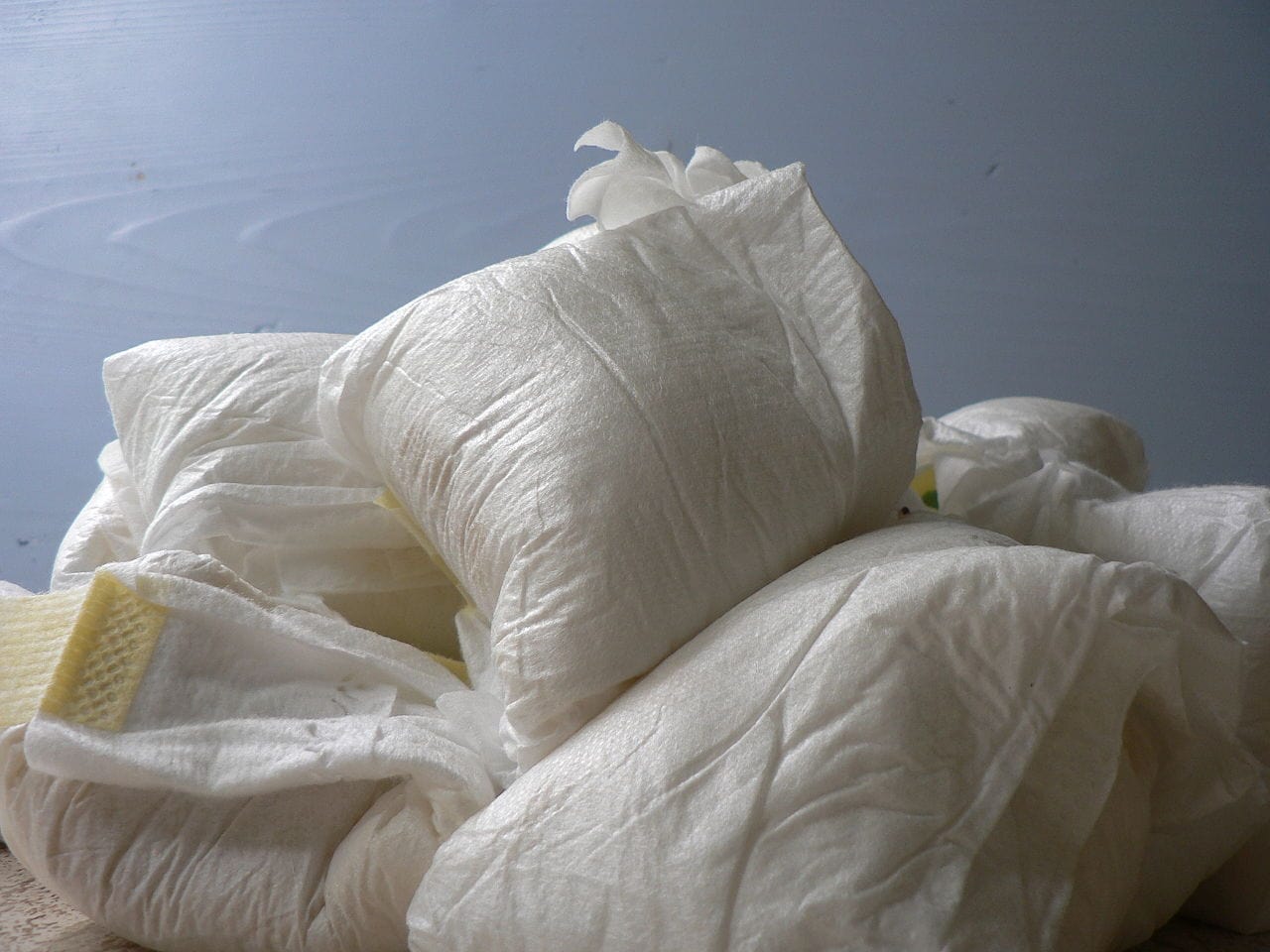
Would you believe that in Germany alone, people toss out over 100,000 tons of diapers every year? This, unfortunately, creates a waste of valuable resources.
And what sort of valuable resources, you may be asking?
Well for one, diaper liners have special polymers known as superabsorbers (SAP).
If diapers are just tossed, it means that manufacturers would always use new polymers to make diapers.
The good news is, researchers at the Karlsruhe Institute of Technology (KIT) have ‘revised’ the recycling process, making it much better.
Usually, diaper recycling needs chemicals; the researchers erased that step and instead switched to UV radiation. This method can break down the chemical chains holding the polymers together.
With this technology, we can recycle diapers at 200 times more speed than the traditional process—and at room temperature.
Once recycled, these polymers can then be transformed into new adhesives and dyes.
The details of this discovery are published in ACS Applied Materials and Surfaces.
Now, these superabsorbers are not only found in diapers. Some other various hygiene and medical products like bandages also use them.
Conventionally, acids were necessary to recycle the superabsorbers, making the process complicated, expensive, and not environment friendly.
So far, only a small portion of diapers have been recycled. The majority of superabsorbers end up in landfills or are simply incinerated. Globally—and annually, about two million tons of them end up that way.
UV light for recycling
Researchers from KIT discovered that UV light, coupled with water absorption, causes the crosslinked sodium polyacrylate polymers to degrade.
Professor Pavel Levkin explained that the UV light breaks the chains, turning them into loose, liquid fibers.
They conducted experiments by soaking liners from regular diapers, exposing them to a 1000 W lamp.
After five minutes, the solid material turned into a liquid. This UV method is, as mentioned, 200 times faster than the acid-based way like in the video below.
Then, what happens to the liquified superabsorbers?
After the quick transformation, the researchers converted the liquid into new adhesives and dyes using existing processes.
Levkin noted that the substance is not only soluble but also processable, opening the door to various product possibilities.
It should be noted that the tests involved clean diapers. However, the team is confident that the method could be applied to separate superabsorbers from used diapers.
The team has proposed optimizing the recycling process with solar power for an eco-friendly approach.
“We have found a promising strategy for recycling superabsorbers. This will significantly reduce environmental pollution and contribute to a more sustainable use of polymers,” Levkin concluded in the research.
Disposable diapers waste issue and their alternatives
Ubiquitous—that’s what disposable diapers are.
According to Ellen MacArthur Foundation, about 95% of families in developed countries use them.
They’re everywhere and very popular, simply because of convenience. Annually, diapers contribute to a market worth over $60 billion.
It doesn’t matter if there are declining birth rates in some areas of the world. Because, the adult diapers market is on the rise. It’s projected to hit $19 billion by 2031 as the aging population grows.
In a developing world where most people are uneducated, the impact of single-use diapers is more severe.
Aside from the lack of education, there is also a lack of waste infrastructure and effective policies for disposal.
According to 2018 World Bank report on marine debris in Indonesia, fifth of waste in the waterways consists of nappies. People simply toss them into rivers and other waterways.

As a result, plastic fibers, likely from these diapers, are found in in the stomachs of fish in Javanese rivers. Moreover, West African fishermen report hundreds of nappies along the coastline.
It’s already bad enough to find microplastics inside our food. The concerns, however, lie more on the nappies’ insides. There are harmful chemicals which can hurt not only themselves (and children) but also the environment.
We’ve come a long way from the old cloth with pins. Nowadays, reusable diapers have more fitting shapes and washable inners. More people have used this modern alternative.
Good reusable nappies might have more upfront cost, and that might turn some people off. After all, the single-use ones are cheaper and very convenient—there’s no need to wash and clean every single time.
Why don’t we change the key materials instead?
When we look at superabsorbers, it seems like they’re problematic. Some of you may come up with the idea to change the materials—it’s better to prevent, right?
That’s an excellent suggestion. And thankfully, a scientist has recently crafted an affordable and eco-friendly SAP.
How can the superabsorber be eco-friendly? Well, it’s made from starch.
Professor Hiroshi Uyama wanted to address the growing environmental issue tied to disposable diapers.
To do that, the Osaka University professor mixed starch with a natural organic compound found in items like lemons. Then, Uyama added a small amount of water.
Combined, the professor developed SAP that micro-organisms can break down.

Uyama’s polymer chemistry technology enables the SAP to absorb water and artificial urine up to 20 times its original weight. That’s a significant improvement when compared to previous attempts that were 100 times more expensive.
In his lab, he is equipped with cutting-edge tools like an electron microscope, a specialized camera, and a strength analyzer.
Uyama then demonstrated how the solid powder efficiently absorbs fluids due to the mesh-like structure of the SAP.
“I’ve managed to create better interstices. That was fortunate,” Uyama said, referring to SAP’s porous design.
Unfortunately, Uyama couldn’t reveal exactly how he produced his SAP, as he’s pursuing a patent.
But, he believes the relatively straightforward technique could lead to efficient mass production of this innovative SAP variant.
Biodegradable SAP in diapers soon?
Disposable diapers, as we know, currently rely on SAP made from non-biodegradable polyacrylic acid.
According to Japan’s Environment Ministry, disposable diapers accounted for 5.2% to 5.4% of general waste in fiscal 2020. Estimates have projected an increase to 6.6% to 7.1% by fiscal 2030 due to an aging population.
Uyama’s breakthrough offers us an eco-friendly alternative. We just need to wait for his large-scale production.
What is known so far is that Uyama has collaborated with private businesses and other entities.
Together, they’ve worked to produce biodegradable plastics and films from starch, focusing on addressing the diaper waste issue.
Their ultimate goal is to create disposable diapers exclusively from biodegradable materials. Furthermore, they wanted to make the diapers compostable instead of requiring incineration with regular trash.
“The waste from paper diapers is becoming a significant concern in society. I’m hopeful that we can contribute to reducing its volume,” Uyama said.
Sources
https://www.sciencedaily.com/releases/2023/10/231025110614.htm
Leave a Reply