


Sharks.
They have roamed the oceans for over 400 million years, survived five mass extinctions, and evolved into different shapes and lifestyles.
One can be in complete awe when one sees them, or one can freeze in fear. Well, depending on the type of shark, really.
But as we know, these majestic creatures are facing a serious threat.
Sharks are one of the most endangered species groups worldwide, largely due to unchecked fishing practices and wasteful finning.
We’re also aware that governments worldwide have put in place various rules to curb shark catch and finning. We’ve also seen campaigns done by celebrities to discourage finning.
No one really knew how effective these measures were until recently.
A fresh global assessment has shed light on the situation. It reveals that while some rules are helpful, sharks are still being caught at an alarming rate by coastal fisheries.
Published in the journal Science, the findings come from a dedicated team of researchers. They examined shark catches from 2012 to 2019 across 150 fishing countries and the high seas.
They also talked extensively with shark fishery experts to understand current trends better.

More sharks killed
Led by researchers at Dalhousie University, UC Santa Barbara, and The Nature Conservancy, the team made a surprising discovery.
Despite an increase in protective legislation against finning, the total number of sharks killed by fisheries each year is not dropping. In fact, it’s actually creeping up.
A significant portion of these catches involve species at risk of extinction.
When accounting for sharks that aren’t properly identified, the estimated global mortality in 2019 rose to 101 million sharks.
Senior author Darcy Bradley said, “This unsustainable fishing of sharks is a massive global problem that could wipe out some of our planet’s most ancient and beloved species.”
The increase in shark mortality primarily stems from coastal fisheries, which are responsible for 95% of shark deaths globally.
Regulated open-ocean fisheries have seen a decline in shark mortality. But at the same time, coastal fishing has steadily increased by 4% between 2012 and 2019.

The researchers found that while laws against shark finning have been somewhat successful, they haven’t reduced overall mortality.
In fact, the laws may have unintentionally led to more shark catches, as the demand for shark meat rises.
This team emphasizes the importance of stronger measures to reduce shark catches overall. They pointed out successful examples like complete bans on shark fishing in designated sanctuaries.
They also stress the need for better reporting and transparency in shark catches to evaluate the effectiveness of conservation efforts accurately.
Basking sharks experiencing a sharp decline
Better reporting and transparency get increasingly important as populations of sharks keep decreasing.
According to a recent study, there’s been a significant decline in basking shark sightings in the California Current Ecosystem (CCE) since the 1970s and 1980s.
And per the International Union for Conservation of Nature’s Red List, these sharks are listed as endangered.
The tricky thing about basking sharks is that they’re mysterious. We still know little about their lifespan, mating habits, or birthing locations.
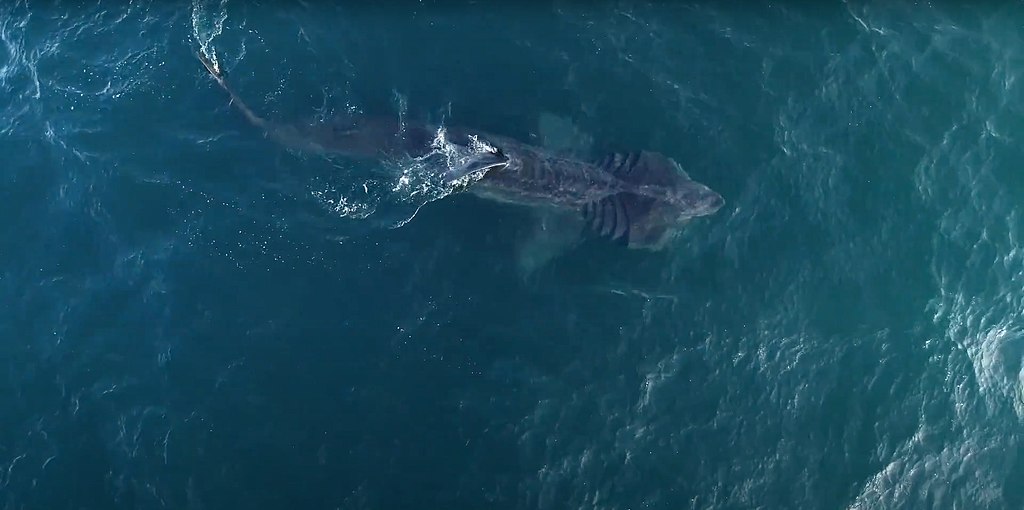
There are no population assessments in the CCE region, and there’s no formal monitoring program dedicated to the species.
Existing data, however, does indicate clearly that there’s a need for further investigation.
Lead author of this study Alexandra McInturf said, “We’re eager to understand the reasons behind these declines. Is it climate change? Human activities? What environmental factors influence them, and how might these change in the future?”
In the study, researchers analyzed the longest available dataset. Such a dataset consists of systematic aerial surveys conducted by NOAA Fisheries between 1962 and 1997.
They also took additional data sources that spanned from 1973 to 2018. Those include fisheries data, tagging efforts, research endeavors, and public observations.
Population decline and changes
Aerial surveys in 1965 spotted a maximum of 4,000 basking sharks.
However, after the 1990s, sightings plummeted, with fewer than 100 reported annually.

School sizes also decreased by about half between the 1960s and 1980s. Moreover, no schools larger than 10 individuals were reported in following decades.
Co-author Heidi Dewar explained, “While the primary focus of aerial surveys was on small fish, the data collected on basking sharks proved to be invaluable.
“Currently, fishing for basking sharks is banned in the U.S., Mexico, and Canada. We hope that these protective measures will aid in population recovery. However, further efforts are necessary to understand mortality sources in international waters.”
The study also revealed a notable shift in the timing of sightings. There was a change from fall and spring in earlier years to the summer months after the 2000s.
Reasons and causes behind these trends remain unclear. However, researchers observed a significant correlation between shark presence and environmental factors.
Sea surface temperature, prey abundance, and climatic oscillations like El Niño are among those factors.
The study emphasizes the need for more research to fully understand the basking sharks’ habitat range.
Recommendations

The study concludes with several suggestions for conserving the species.
Researchers of this study emphasized the importance of coastal areas from Monterey Bay to Baja California. Those areas are crucial basking shark habitats.
Recommendations from the researchers include:
1. Coordinating the documentation of basking shark sightings and mortalities across the Pacific basin to improve population estimates.
2. Enhanced monitoring of shark fin markets.
3. Development of region-specific genetic markers to ensure compliance with regulations governing international trade in endangered species.
McInturf also highlighted the importance of raising public awareness about these sharks.
Basking sharks feed near the surface. And when they do, they’re vulnerable to ship strikes.
This makes boater education a crucial aspect of conservation efforts.
How does one identify a basking shark?
Due to their large bodies, basking sharks were once mistaken for great white sharks. Sailors and fishermen of yore mistook them for sea monster, as well.
If you search their images on the internet, you’ll see that they have enormous mouths.
“We often get questions like, ‘Could they swallow a person?’ No, their throats are too small,” McInturf said.
With such a mouth, basking sharks primarily feed on tiny phytoplankton. They filter the tiny creatures through their massive mouths just like whales do.
Other than their large mouths, key identifiers of a basking shark include a large dorsal fin. One might be able to see a smaller dorsal fin, too.
While feeding, their tail or nose may break the water’s surface.
Most sharks swim directly. But basking sharks tend to move in a zigzag or snakelike pattern through the water.
McInturf shared her experience of seeing a basking shark breach out of the water in Ireland. She noted the challenges of studying these elusive marine animals.
“It gives you an idea of what it’s like to work with basking sharks. I would love to encounter them in the water again. Despite spending so much time searching for them, they’ve proven incredibly difficult to find,” McInturf said.
sources:
https://phys.org/news/2024-01-global-reveals-pathways-threatened-sharks.html
https://www.sciencedaily.com/releases/2022/02/220222151914.htm
Leave a Reply