

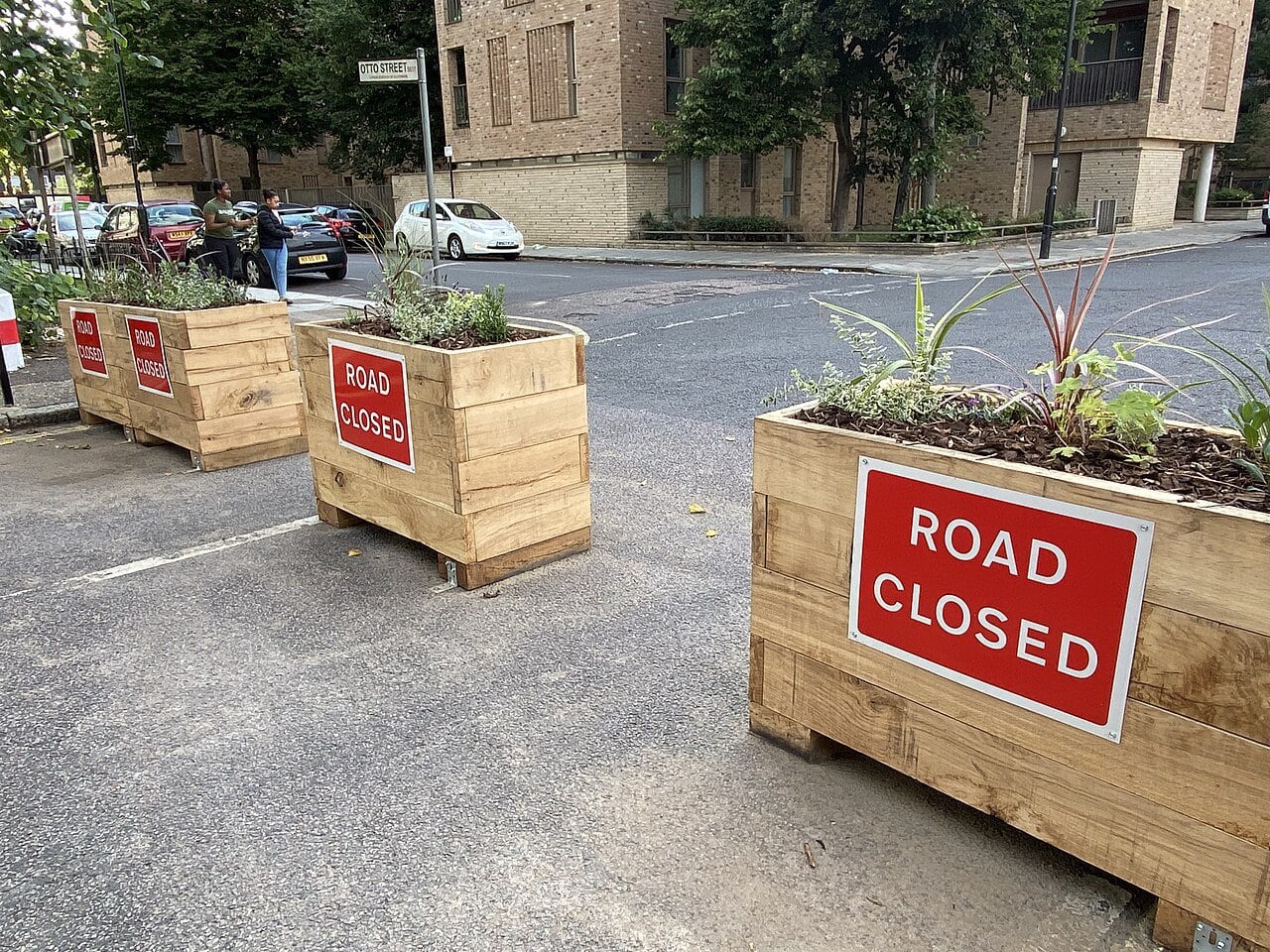
Low-traffic neighborhoods (LTN) initiatives have been around for quite some time, but ever since the pandemic hit, policymakers have installed more of them.
Other than encouraging active travel (mobilizing by walking or cycling) and creating a more pleasant environment for pedestrians and cyclists, LTNs also aim to address three public health issues directly associated with rampant car use in urban areas: air pollution, road deaths and physical inactivity.
In the UK only, human-made air pollution is linked to between 28,000 and 36,000 deaths each year. This pollution is even worse in congested cities. That’s why when there were lockdowns, policymakers took the opportunity to keep the air clean with the initiative.
However, LTNs have become a topic of debate in the UK.
Some critics have even accused the government of greenwashing, arguing that these initiatives have caused more congestion and air pollution on boundary roads. Moreover, they argued that LTNs have caused longer emergency response times and increased travel times for disabled people or carers.

Why some people don’t really like LTNs
Some environmentalists may think that people who are not fans of LTNs don’t care about the environment.
However, we should remember that when one road is closed, if there’s no better alternative or city planning, there will be more traffic congestion. And with it, more journey times and more air pollution in other areas, which can divert to neighboring streets.
One criticism about the negative impact of longer journey time is the potential delays they can cause for emergency services. There are videos online which show fire engines and ambulances unable to get past bollards or planting boxes.
The success of LTN initiatives depends quite heavily on how residents feel about it. If they don’t like it, closure of LTNs is imminent. For example, in both Ealing (a district of west London) and Warrington (a town in northern England), councils removed LTNs after the objection of residents.
Differing policies from policy makers
In the UK, the temporary re-opening of an LTN has led to an argument between politicians. One side argued that there should be more air quality monitoring when it’s re-opened so that the residents will get less impact from air pollution.
They said that the re-opening (while another street is closed for roadworks) could provide a unique opportunity to gather comparative data but despite frequent requests, the new administration has failed to act.
Another side, however, argued that while the initial LTN proposal was good in principle, it didn’t regard the residents living on nearby roads who, it turned out, had been impacted by the changes.
UK’s Labour councilor Pete Kilburn stated that there should be more consideration on the potential impacts as well as examining interventions in a more strategic way.
“Labour is now developing a transport and movement plan that will consider these impacts, meaning any changes we propose will be beneficial rather than damaging to people’s health,” Cllr Kilburn said.
Upon hearing the argument from The Liberal Democrat and Labour politicians, joint Executive Member for Environment and Climate Emergency, Cllr Kate Ravilious said that the former party had had no interest in air quality impact on schoolchildren and residents when implementing the LTN.
According to the councilor, the latter, on the other hand, thought more broadly. The party will be “addressing the congestion and air quality issues on nearby surrounding roads and elsewhere across the city too as part of its transport and movement plan currently in development,” Cllr Ravilious said.
_trial_of_a_modal_filter_in_the_London_Borough_of_Kingston_upon_Thames.jpg)
Positive outcomes from LTN initiatives
Despite being here for quite some time, with varying implementations, LTNs are not always perfect. And like in the argument of the British parties above, premature policy decisions may lead to several adjustments—along with the oppositions and approvals.
And since most LTNs were widely installed during the pandemic, which is very recent, there’s still limited information on their long-term effects and impacts beyond one area.
Despite the criticisms and drawbacks, the existing evidence still offers a clearer understanding of how LTNs can positively impact various aspects of urban life.
Nonetheless, the existing evidence still offers a clearer understanding of how LTNs can positively impact various aspects of urban life.
Encouraging more active travel
According to some recent studies, LTNs are effective in reducing car usage. Recent research on four LTNs in the south London borough of Lambeth found that the annual distance residents within these LTNs drove decreased by 6% compared to control areas.
This finding is in accordance with previous research that examined traffic data from 46 LTNs across 11 London boroughs. The study showed a substantial reduction in motor traffic within LTNs compared to the expected background changes.
Moreover, there was no evidence of traffic being systematically displaced onto boundary roads.
Then, a separate study by researchers from Imperial College London on three LTNs in the London borough of Islington discovered notable improvements in air quality after installation.
In the Imperial College London study, levels of nitrogen dioxide decreased by 5.7% within the LTNs and 8.9% on boundary roads on average.
Furthermore, between 2015 and 2019, rates of car ownership in outer London LTNs reduced by 6% relative to control areas. So, in the capital, LTNs have even been associated with decreased car ownership and improved road safety.
Unfortunately, the shift to active travel prompted by LTNs is more limited. But a study funded by Transport for London on LTNs that pre-dated COVID in London’s Waltham Forest, found a 1–2-hour increase per person in weekly active travel compared to the control area.
Additionally, concerns over longer journeys for emergency services were also examined, albeit in only one published academic study. In that study, the researchers found no negative effects of LTNs on fire service emergency response times in Waltham Forest. In fact, response times even improved slightly on some boundary roads.

Copying other LTNs
When we want to compare LTNs, some countries with long withstanding active travel like the Netherlands will come to mind. In this country, active travel has been separated from car traffic consistently since the 1970s.
In the UK’s case, some experts argue that relatively few of the UK’s more recent LTNs have altered street layouts to encourage new uses.
According to them, if governments LTNs implemented a stronger focus on urban design and physical changes to the streetscape, they could have a potentially transformative effect on how people feel about and use residential streets.
Another good example that the UK can follow, per the experts, is initiatives in Barcelona. The policymakers installed LTNs where pedestrians and cyclists are prioritized over motorized vehicles. Although, they don’t call it LTNs there, they’re called superblocks.
After the implementation of Barcelona’s Sant Antoni superblock, research found a 33% reduction in nitrogen dioxide emissions, an 82% reduction in traffic within the superblock and a 28% increase in public space to walk and play in.
Basically, with great planning, LTNs can work very well. The UK as well as other parts of the world can take a look at other governments which have successfully implemented the initiative.
So… effective or not?
The question at the end is… are they really effective? Well, in my opinion, in terms of reducing car dependency and encouraging active travel (which ultimately clears the air and minimizes carbon footprint), yes.
From the studies above, although limited, we can see that LTNs have their own merits. I personally believe that when governments implement better city planning, they can integrate LTNs well, and it’s a win-win for residents and the environment.
It’s just that for now, studies on LTNs are limited and since it’s relatively new in terms of wide installations, the current LTNs feel like doing a trial and error.
That said, I think that in the future, when there’s a better implementation of LTNs and city planning, everybody and the environment can reap their benefits.
Sources
Leave a Reply