

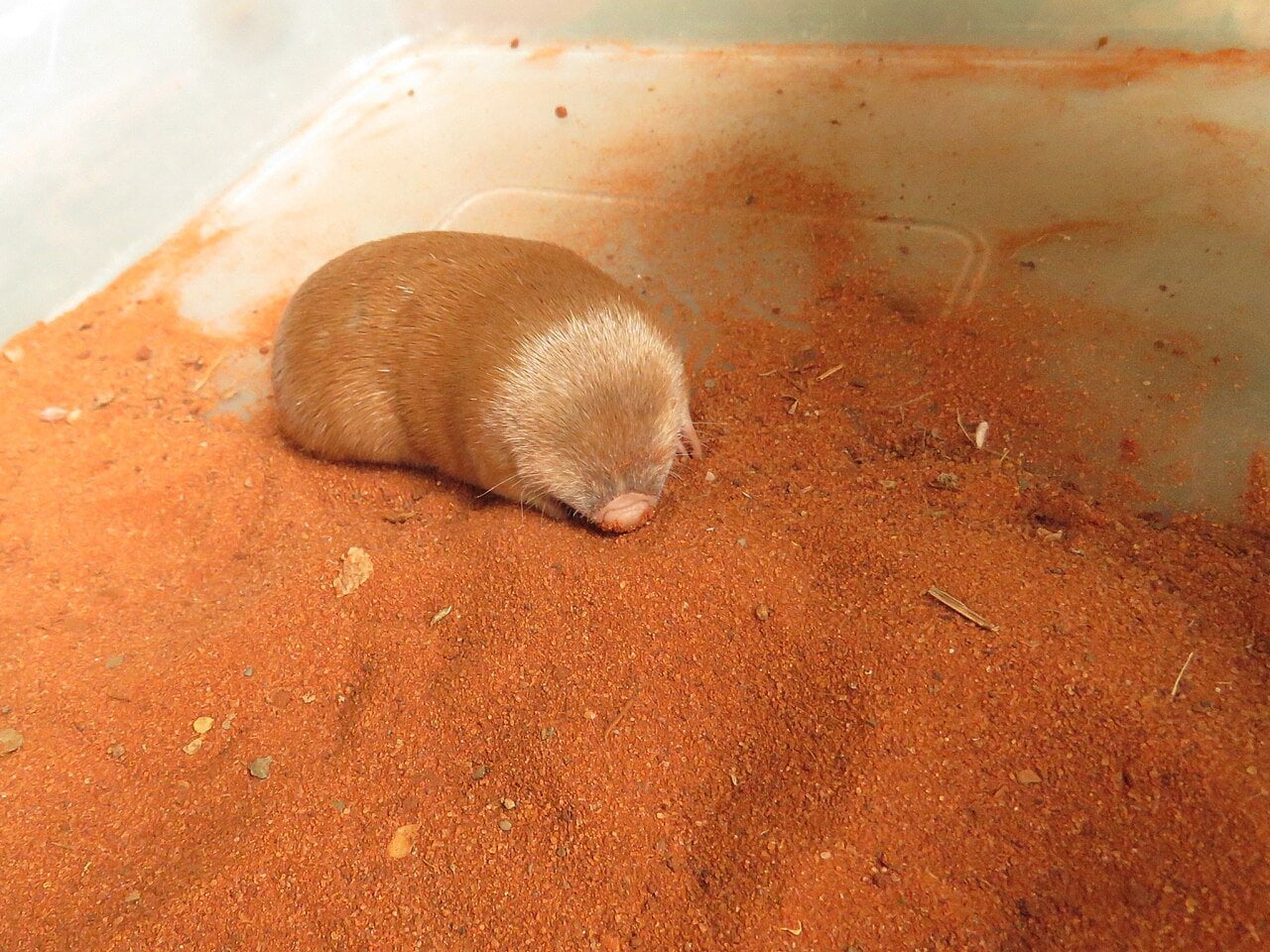
De Winton’s golden mole is true to its name. It’s a blind mammal with amplified hearing which bears shimmering shades of gold on its coat.
Like its cousin, the mole that one might see in one’s garden, the golden mole burrows itself underground.
Unfortunately, De Winton’s golden mole has had habitat problems with humans. They’re greatly affected by diamond and mineral mining activities on the South African west coast.
That is why, before its recent rediscovery, the species was last seen in 1937 on the north-western coast of South Africa.
Now, the mole ‘swims’ through sand dunes and does their best to avoid contact with humans. It was impossible to find them, particularly with technology and advancements from that age.
So, sometime later, it was declared lost.
In November 2023, however, a team of conservationists and geneticists found the mole. They did it by tracking its environmental DNA through the sand dunes.
Elusive sand-dwelling critter

Molecular biologist Samantha Mynhardt was a part of this team. According to Mynhardt, golden moles are elusive and rarely seen by humans.
Some golden mole species do occasionally come to the surface to forage on insects, but only at night.
The only sign of a golden mole activity is a raised ridge on the surface of the ground. That indicates a shallow tunnel underneath.
Unfortunately, for De Winton’s golden mole (Cryptochloris wintoni), the ridges are hard to find. Sand dunes are soft, so subsurface tunnels collapse easily.
The golden mole has eluded scientists for about 8 decades. They were last seen in the 30s around the small harbour town of Port Nolloth.
One reason is due to difficulties in locating and trapping it. Another is that a similar looking mole, Grant’s golden mole (Eremitalpa granti) also lives around the area.
In 2020, the team did a study on De Winton’s sister species, the endangered Van Zyl’s golden mole (Cryptochloris zyli). In the study, the researchers found that their newly developed methods would work to detect golden moles.

From there, they tested their trial. In 2021, the researchers began their expedition across the west coast of Port Nolloth. As mentioned, it’s the only site where De Winton’s golden mole had been found.
The researchers, with the help of a border collie, surveyed the sites on foot for a week. Together, they explored 18 kilometers of dune habitat every day.
Jessie, the border collie, had obviously never seen any De Winton’s golden mole before. But, the researchers had trained her using other golden moles.
If she picked up the scent of similar species, she’d let the researchers know. Therefore, when the team found golden mole tunnels and Jessie didn’t show interest, it was a sign of something new.
Traces of environmental DNA
After utilizing the pooch to sniff out tunnels, the team collected over 100 soil samples from them.
Now, animals like moles shed their DNA into their environment. Usually, the DNA is found in skin cells, hair, excretions and secretions.
However, in this case, the environmental DNA (eDNA) is minuscule—invisible to the human eye, even.
The team then extracted the eDNA from the soil and barcode-sequenced it. It matched a De Winton’s reference sequence taken in 2010 from a museum specimen.
Most people doubted that the mole still existed. However, the researchers believed that it had not gone extinct yet.
That’s why they were adamant that it was just about finding the right way to find and study it.
And now that they know how eDNA tracking can be helpful, the researchers want to find other lost or endangered species.
So… How many of De Winton’s golden moles still exist?
According to Mynhardt, there was a lot of golden mole activity in Port Nolloth. While the team is not too certain about the exact numbers, it’s likely that there’s a healthy population there.

Also, the researchers detected the golden mole’s presence around additional sites. It indicated that the species may be more widespread.
Moreover, they did capture two De Winton’s golden moles—something they hadn’t expected.
The first one was from Port Nollot, while the second one was from the surrounding area. They confirmed which species it was via swabs and DNA sequencing.
Although for now, the researchers can’t estimate the population size, they’re excited about this discovery.
The rediscovery of De Winton’s golden mole offers us the chance to learn more about the poorly understood mammal.
At the same time, it also gives us hope of finding other species that are presumed to be extinct.
Hopefully, this discovery and research could also offer some ways to conserve these imperiled golden moles.
The golden mole’s rediscovery isn’t the only good news to share. In Australia, a presumed-extinct penguin colony has returned after 30 years.
Penguins returning after 30 years
For the first time since 1993, a new penguin chick has hatched for the first time. This indicates that the locally extinct colony of little penguins has reestablished itself.
Local conservationists observed the chick near Eagles Claw Nature Reserve in Eden, in the Australian state of New South Wales. The chick was found after a breeding pair returned to the area after years of being lost.
One of the many reasons why the penguins went missing is introduced predators like foxes and dogs. No, not just wild dogs, domestic dogs as well.
Little penguins are the smallest of all penguin species, as they grow to only around 12 or 13 inches tall. This has earned them another name, fairy penguins.
.jpg)
They are found across southern Australia and much of New Zealand. Before, they used to be more common in mainland Australia, but now they inhabit offshore islands.
“Populations along mainland coastal New South Wales (NSW) are rare,” said Nicholas Carlile, a senior research scientist at the NSW Department of Planning and Environment.
As mentioned, the little birds are mostly under threat from introduced animals like dogs, cats, ferrets, stoats, and foxes. However, they are also affected by oil spills.
Carlile explained, “The town of Eden boasted a penguin population of more than 20 pairs up until the early 1990s, when the dual impacts of predation, by feral European fox and domestic dogs, and nest inundation from storms, rendered the colony extinct.
“The only surviving coastal population in NSW, in the Sydney suburb of Manly, has been maintained through significant effort by conservation managers over the last 20 years.”
Helping as human love doctors
Conservationists first spotted the mating pair in late 2022 as they first began to form a pair bond.
Together with the NSW National Parks and Wildlife Service (NPWS), and Bega Valley Shire Council, conservationists have removed weeds and protect the area from foxes.
Also, they kept a close eye on the pair with a wildlife camera as the penguins built their nest.

“The re-establishment of the Eden colony was made possible by the installation of a predator-proof fence in a coastal sea gutter that is unlikely to suffer from storm surges,” Carlile said.
And now, the area has been optimized to attract more little penguin mating pairs. Conservationists have built artificial burrows for them. They have also set up a so-called “love machine” that plays the penguin’s mating calls.
“A sound attraction system was installed to give the impression that the site contained many productive penguins,” Carlile added.
Conservationists hope that, since the initial effort has been fruitful, there will be more adult penguins to join this pair in the future.
If their efforts continue and more chicks will have hatched here, a colony will really be established over time.
Well, let’s keep supporting the conservationists slash love doctors so that little penguins can thrive in Eden.
sources:
https://www.newsweek.com/little-penguin-colony-australia-returns-chick-hatched-1833766
Leave a Reply