


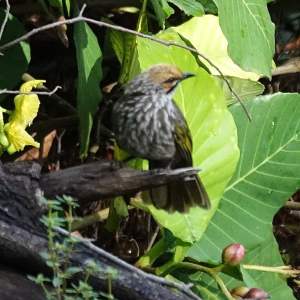
At Hindhede Nature Park, central Singapore, one can hear a lot of bird calls in the early morning. However, the song of the straw-headed bulbul (Pycnonotus zeylanicus) stands out.
Conservationist Ho Hua Chew, one of the first to study this bird in Singapore gushed over the species. “Whenever I hear its resonant, bubbly song, the forest seems to erupt with life,” Ho said.
But it’s precisely due to the species’ distinctive song that it has been a prime target in the Asian songbird trade.
Each year, thousands of birds with pleasing calls are captured from Southeast Asia’s forests for home entertainment or singing competitions. It has caused their wild populations to plummet, with over 40 species severely threatened by this trade.
Because of this demand, the straw-headed bulbul has suffered greatly.
The International Union for Conservation of Nature (IUCN) lists it as critically endangered.
In Thailand, Myanmar, Java and Sumatra (in Indonesia), the bird is believed to be extinct. Moreover, populations in peninsular Malaysia and Indonesian Borneo are also declining rapidly.
Singapore has risen up to be a place of refuge for the species, much to my embarrassment as someone who’s from one of the formerly mentioned countries.
The city-state has seen a slow but steady increase in its population, thanks to over three decades of dedicated conservation efforts.
As of 2020, Singapore hosts about 600 straw-headed bulbuls, accounting between 23 and 57 percent of the global population.
These birds live across Singapore’s main island and the offshore island of Pulau Ubin. Interestingly, the island was once a granite quarry site, now functioning as a crucial nature area for their survival.
Conserving the bird

As briefly mentioned, efforts to protect the species in Singapore began more than 30 years ago.
The efforts were initiated by a conservationist group called Nature Society Singapore, with Ho serving as a key member since the mid 80s. It was when Ho and the others led a campaign to protect Pulau Ubin and other zones on the main island.
Ten years later, the group published the master plan for the Conservation of Nature in the country, highlighting the need to conserve these areas.
At the same time, the group used newspapers and other forms of media to raise public awareness about the country’s biodiversity.
Thanks to their efforts, Pulau Ubin became a designated nature area in 1993.
By 2001, estimates suggested about 76 to 93 straw-headed bulbuls lived on the main island, with at least 64 adults on Pulau Ubin. However, continued threats made their population go down by 50% by 2008.
Ho first saw the straw-headed bulbul in 1987 at Pulau Ubin. For his master’s thesis in 2001, he studied this population. It turns out that the bird prefers the edges of its habitat rather than the interior.
This means that efforts to conserve the bird don’t need an extensive forest area. And that it’s possible for the species to survive near urban areas.

At the same time, excessive fragmentation of forested areas can still harm the birds by depriving them of essential resources like food and nesting sites.
Now, what makes Singapore different is that there are high awareness levels in Singapore that go along with strict environmental laws. Poaching, trapping, and trading of this species hasn’t been a major issue here.
In addition, more habitats of the species on the main island, such as the mangroves of Mandai and Khatib Bongsu, are also being granted protection.
habitats of the species on the main island, such as the mangroves of Mandai and Khatib Bongsu, are also being granted protection.
Future plans for conservation
After three decades of awareness efforts, Nature Society Singapore and BirdLife International organized the first workshop for the conservation of the straw-headed bulbul in May 2019.
Participants gathered to share knowledge and identify necessary conservation measures for the species in Singapore.
This workshop led to the formation of the Straw-Headed Bulbul Working Group in 2021. It includes government agencies, local and international conservation nonprofits, and universities
Then, after two years of consultations, the group released the National Species Action Plan. It’s a five-year project aimed at ensuring the species thrives in Singapore.
The plan focuses on enhancing monitoring and observation of the species, documenting the genetic diversity of the local population.
It also focuses on raising awareness about the bird’s conservation and collaborating with urban planning authorities to protect its habitat.
Moreover, the plan aims to monitor bird shops and farms to prevent the commercial import of straw-headed bulbuls into Singapore.
Though not directly involved with the Species Action Plan, Ho is enthusiastic about its launch.
He believes that successful implementation of the plan could help revive straw-headed bulbul populations in areas where the bird is now either extinct or close to extinction.
_(7936876438).jpg)
Another positive development for the conservation of the straw-headed bulbul came in November 2023 when the species was added to Appendix I of the Convention on International Trade in Endangered Species of Wild Fauna and Flora (CITES).
This appendix lists the most endangered species, and being added means that international trade in the bird is prohibited except for noncommercial purposes like scientific research.
This move signifies Singapore’s commitment to tackle the global issue of illegal wildlife trade.
And since then, thanks to the conservation measures led by Singapore and its dedicated conservationists, the species’ future looks brighter.
Again, it’s regrettable because my own country, despite its own efforts, doesn’t give a solid protection for the bird.
Singapore’s Eco-Link caught a sight of critically endangered Raffles’ banded langur
Another good piece of news in Singapore doesn’t stop with the straw-headed bulbul, as the country’s Eco-Link@BKE spotted a Raffles’ banded langur for the first time.
It’s a promising sign that the monkeys might be expanding to other forested areas to find food and/or mates.
.jpg)
For those who don’t know, the 62m-long, 50m-wide Eco-Link@BKE is an ecological bridge connecting the Bukit Timah and Central Catchment nature reserves.
Singapore’s National Parks Board (NParks) stated that the interaction of wildlife between the two nature reserves via Eco-Link@BKE aims to prevent genetic isolation.
It also aims to promote a bigger spread of their genetic pool, reducing the occurrence of inbreeding and ensuring a higher chance of the survival of the species.
This sighting indicates that the link bridge is helping to expand the langur’s habitat and boost its survival chances.
According to the country’s National Development Minister Desmond Lee, the langurs were last seen in Bukit Timah Nature Reserve in 1987 and are typically found only in the Central Catchment Nature Reserve.
The tree-dwelling monkeys are endemic to Singapore and southern Peninsular Malaysia. They were once predicted to face extinction due to habitat loss and fragmentation.

Ten years ago, their population was estimated to be as low as 40. But today, the number has increased to 76.
This sighting is concrete evidence that the species is using Eco-Link@BKE. While there have been previous sightings of the langurs west of the BKE, this sighting confirms the link bridge’s use.
Before, the langur might have crossed via Rifle Range Road which runs over the BKE. because, in 2017, there was a langur found dead; it likely attempted to cross but not using the bridge.
In fact, in 2022, two Raffles’ banded langurs were found dead in separate incidents within 24 hours.
But all in all, this sighting gives hope.
A 2023 study found that the langur population is expected to double to 150 in the next 15 years. It might go up to more than 240 monkeys by 2071.
With continued conservation efforts, there might be more good news about the langur and the bulbul in the future.
Sources
Leave a Reply