

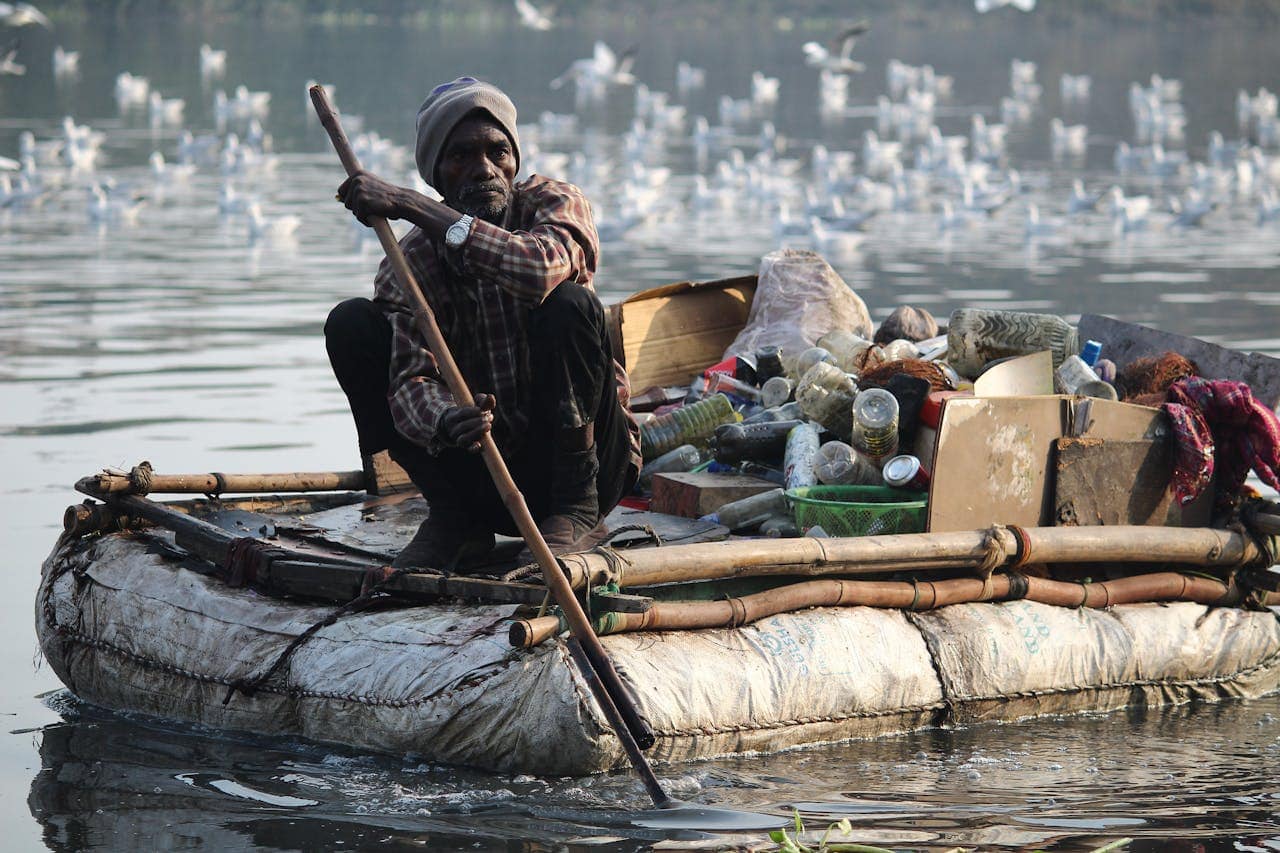
In most pollution situations, plastics lie at the heart of them.
These materials destroy natural environments but that’s not the only thing. They break down into particles which we can find throughout air, water, and food.
But it’s just so hard to completely give up on these things.
“The problem with plastics is they are just so bloody useful. So how do we keep their usefulness in a way that’s friendly to the environment?” Said Cameron Hepburn at the University of Oxford.

That question drove Hepburn and colleagues to come up with a roadmap which was published in the journal Nature.
Per the researchers, their plan is to build a circular, zero-carbon economy in which we continue to use plastics.
It’s a bold plan, but it’s necessary for the environment (and us, too).
We all know the news by now: plastics are within our blood and organs. We don’t know the effects they bring on our health, but they’re there.
“Most of the carbon for plastics comes from petrochemical feedstocks under the ground. What happens when your plastics degrade is you’ve taken a bit of carbon from under the earth and it’s ended up in the air,” Hepburn said.
When plastics are everywhere
Finding solutions for this isn’t as easy as flipping a coin. Plastics are essential to almost every industry–it’s also important for the future.
Author of the study Charlotte Williams said that there were many beneficial future technologies that depended on plastics.
For instance, blades of wind turbines are polymer composites, while EVs require large quantities of plastics.

“This means that we really need them, but we must re-design them to be much more sustainable. The challenges here are not only technical; they are also sociological, public policy, economic and legal,” Williams said.
So, we’re in a web of complexity. Moreover, our current efforts to tackle the problem have been less than effective.
Globally, only 9% of plastic waste gets recycled. The rest is burnt or left to decompose in nature.
We’ve made mistakes so far, but one stood out most. Instead of trying to tackle plastics at the system level, responsibility has been largely pushed onto individuals.
Based on these challenges, the researchers made a roadmap for a new, plastic economy that’s suitable for our planet.

Taking the focus off individuals
The roadmap is based on four targets that take the focus off individuals. It focuses on systems change. Those targets include:
- Reducing demand for plastics by 50%. This is achievable by getting rid of products like single-use plastics with the help of policies. Hepburn said that reducing demand will lead to smaller problems.
- Changing plastic-manufacturing ways. A good start would be shifting away from the use of fossil fuels.
“All of the incoming carbon for plastics needs to be either from the biosphere—trees or plants—or directly from the atmosphere,” Hepburn said.
One can produce plastics from a variety of sources, namely mushrooms and algae. For this, however, R&D investment is required to establish the most cost-effective options.
- Maximizing recycling. The study says that about 95% of plastic waste can and must be recycled.
One can improve this through targeted investment and laws regarding producer responsibility. This shifts the responsibility for a product’s lifecycle to the producer.
- Minimizing environmental impacts. This can be done through measures such as improving manufacturing and supply chain transparency.

This makes sure that products don’t contain harmful chemicals. It also ensures integration of manufacturing and recycling with zero-carbon energy.
The research doesn’t offer a detailed guide to designing a new economy, it simply showcases priority areas.
Furthermore, the authors note that their suggestions won’t be sufficient to achieve a circular plastics system.
Williams said, “It is only by taking all four actions together that we can tackle their negative environmental impacts.”
Have actions been taken?
There are signs that the world is ready for change. For example, the paper states the UN’s Environment Assembly (UNEA) to negotiate a legally binding, global treaty on plastic pollution. The treaty takes into account the full lifecycle of plastics.
This could potentially push national and local governments to upgrade their plastics policies which will help the planet and people.

“We must strongly support the UN in trying to deliver a unified and legally binding treaty to govern the future production, use and disposal of these materials,” Williams said.
Hepburn highlights the importance of a shift in perspective, emphasizing the need for producer responsibility to drive transformative thinking.
Placing responsibility on producers to manage the end-of-life impact of plastics can bring about the change we need. It can trigger a more conscientious approach to product design.
In essence, this concept revolves around the idea of holding producers accountable fully.
When one holds companies for the entire lifecycle of their plastic products, they will be compelled to ensure safe and rapid degradation. This can lead to more holistic design decisions, creating a ripple effect in the entire production system.

Jennifer Allan, an expert in environmental and waste policy, applauds the research, Allan acknowledges the strong link it establishes between plastics and the oil industry.
She suggested that the surge in non-renewable plastic production by the oil industry is intentional. It’s a response to the potential decline of fossil fuels in the face of growing renewable energy sources.
According to Allan, plastics have become a substantial driver of oil demand.
Paying attention to chemical additives
As much as she’s appreciative of the study, Allan wants more researchers to focus on another thing. She calls for greater emphasis on policy options to address harmful chemical additives present in plastics.
The expert highlights concerns about additives like “forever chemicals” (PFAS), found in the bloodstream of high-profile European politicians.

Recycling plastics that contain those chemicals poses additional risks of exposure to these harmful substances.
So despite the applause, the study’s roadmap faces questions regarding clarity on policy options for managing chemical additives in plastics.
But putting that aside, the research represents an effort for a sustainable future by steering away from the current belief of individual responsibility.
Hepburn emphasizes the impracticality of expecting individuals to solve the plastics problem, as plastics are present in daily essentials,
He reiterates that real change lies in laws that target producers. This could propel us faster towards net-zero emissions and foster a system that aligns with nature’s well-being.
Source:
Leave a Reply