


Earth has gifted us with boreal forests or taigas. Forests that, if you look at the map, shaped like a loose-knit headband across the planet’s northern expanse just below the Arctic tundra.
Imagine the Arctic as the crown, and these expansive woodlands, stretching across Alaska, Canada, Scandinavia, and Siberia, as its jewels.
Now, these forests have been historically protected by remoteness. At the same time, they act as a vital carbon storehouse.
However, they are now facing challenges due to climate change, showing signs of vulnerability.
Boreal forests play a critical role in regulating Earth’s climate. Taigas are known for their vast number of needleleaf conifer trees and home to diverse species.
These forests also support migratory birds and iconic mammals like moose and brown bears.
The current warming temperatures now pose threats to the woodlands. Should the worst happen, the world would face the consequence.
Climate change has made temperatures warmer than ever, even surpassing the global average.
It’s not just us “icy areas” that are experiencing the bad effects of climate change. The heat is affecting the boreal forests at an accelerated pace.
As there’s fewer cold temperatures to maintain the taiga, trees in the north part respond by growing faster.
On the other hand, the southern boreal forests face a different reality. The warming conditions have slowed the growth of cold-adapted trees. This leads to increased vulnerability to insects and fires, as witnessed in Canada and Siberia.

Trees moving away from the heat
If this were a fantasy setting, I’d imagine the trees standing and walking towards places where they could live peacefully. You know, just like the ents from Tolkien’s story, but this isn’t fantasy.
It’s been observed that boreal forests have begun shifting towards the north as the temperatures get warmer. So, there’s a general expectation that the taigas are all moving northward.
Some experts, however, argue that the reality isn’t that simple. Satellite data reveals that there’s a story of both growth and decline in the taigas.
In the coldest northern areas, there’s evidence of increased tree growth and cover.
In contrast, forests in warmer southern regions have a harder time. Hotter and drier conditions, combined with wildfires and logging contribute to tree cover loss.
Satellite technology may offer us insights into these forests. But, understanding the full picture requires a ground-level perspective.
After several field studies, it’s confirmed that boreal trees move northward, especially in Alaska’s Brooks Range.
The field studies suggest that young trees, once grew in lower altitudes, are now thriving miles north of established tree lines.
Despite the changes that have been confirmed and observed, there are still uncertainties.
Can the newly established trees in the far north catch up with the pace of climate change? Will they make up for the losses in the south?
We still don’t know what the future of these boreal forests will be. We also still don’t know what will happen to biodiversity or people who call these forests home.
As the taigas change in response to climate change, closer monitoring is needed. Experts say that combining satellite data with field studies would offer a more comprehensive understanding of the forests.
Experts highlighted the importance of collaborative effort to better understand the future of these forests and protect them.

Communities depending on boreal forests
Now, we don’t exactly know what’ll happen to the boreal forests due to the varying data. But we do know that if the shrinking continues at a fast rate, it’ll put biodiversity and people at a disadvantage.
For example, indigenous communities have noticed the negative impact of the shrinking.
When these people lose current collecting areas, they must search larger areas for the same plant.
Sometimes, they have to request access to other people’s areas. This may lead to collecting plants contaminated by volatile organic compounds, heavy metals or herbicides.
Research suggests that indigenous communities worry about the use of herbicides in their territories. Previous studies in boreal forests have revealed that there have been glyphosate remains in plant tissues for at least a decade.
Elders from First Nations communities are also concerned about the impacts of bioaccumulation.
Bioaccumulation is the gradual piling up of substances like pesticides or other chemicals through the food chain.
These concerns are based on Elders’ own systems of natural law, oral traditions. The concerns are also based on rules of respect and reciprocity in the forest.
Trying to connect with indigenous communities that live in boreal forests may start with involving them to preserve the taigas.
Because, the recognition of species of traditional value is critical in this process. And when there are specific taiga species available, it means that the help of indigenous approaches is needed.
The communities may help with using their ecological knowledge to conserve and respect biodiversity in the boreal forests. As we know, their generations-down knowledge is sometimes better for conservation.

More threats to boreal forests caused by lightning
According to new research, lightning is the main cause of wildfires in boreal forests.
And as the climate is changing, the researchers believe that there will be more of that in the future.
The study, titled “Extratropical forests increasingly at risk of lightning fires,” utilized machine learning to identify the dominant source of wildfire ignitions worldwide. It’s the first one to link fire ignition sources globally.
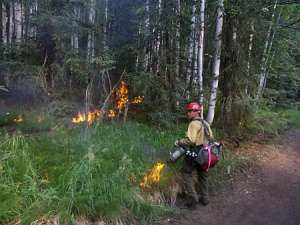
In the paper, it’s revealed that 77% of burned areas in intact extratropical forests result from lightning ignitions. It’s completely different from tropical fires as it’s mostly caused by human activities.
The researchers used climate models to assess how lightning frequency would change with global warming.
The study predicts an 11 to 31% increase in lightning frequency per degree of global warming over intact extratropical forests. Meaning, risks of wildfires will continue as the planet gets warmer.
Lightning fires
Fires caused by lightning are larger and more intense than human-caused ones. They usually happen to remote areas during periods of extreme fuel dryness.
The researchers emphasize the connection between the increasing flammability of forests, more frequent intense fire-prone weather, and a rise in lightning strikes. Together, they pose a threat to our taigas.
As mentioned, boreal forests are crucial for global carbon storage. They store large quantities of carbon in vegetation and permafrost soils.
Despite covering just 1% of the Earth’s land surface, fires in intact extratropical forests contribute over 8% of global CO2 emissions from fires.

While putting a moderate emissions scenario, the model estimates that fires could amplify greenhouse gas emissions from permafrost thaw by 30% by the end of the century.
Senior author Dr Matthew Jones underlined the importance of extratropical forests in sequestering carbon. Dr Jones added that fires in these regions release more CO2 per unit area than almost anywhere else on Earth.
This study comes just in time, considering how Canada had record-breaking fire season in 2023.
Lead author Dr Thomas Janssen explained, “Extreme fire seasons in boreal forests, like the one we saw in Canada this year, will be more likely in warmer climates due to hotter, drier weather and more lighting strikes.”
Concluding the paper, Dr Jones urged for intervention.
“Curbing emissions of greenhouse gases from fossil fuel use and land use change is critical to avoiding the worst additional risks of wildfire in many regions, but especially in the boreal forests where fires are so sensitive to warming,” Dr Jones said.
Sources:
https://www.sciencealert.com/the-worlds-largest-forest-wilderness-seems-to-be-shrinking
https://phys.org/news/2023-11-lightning-wildfires-boreal-forests-threatening.html
Leave a Reply