


I’ve grown to really like octopuses–not as food–that I’ve dedicated a post about them a while ago.
And as some of you might already know from videos, documentary films, and other stories, these animals are highly intelligent.
We’ve also seen videos of them recognising different people, and they’ve shown their playfulness to people they’re comfortable with.
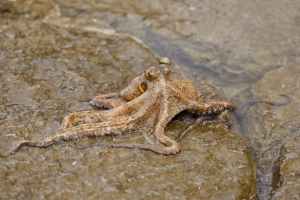
I’ve read multiple comments suggesting that if they had a longer lifespan, they might take over the world. Funny, and also can be true.
Nevertheless, such shows of intelligence now begs the question whether it’s ethical to eat them.
This has made a Spanish company’s plan to raise octopuses for food in factory-like conditions even more controversial.
In the proposed farm near Spain’s Gran Canaria island, the animals would be kept in narrow cages. The cages will be stacked on top of each other inside a multistory industrial facility.
In addition, the company’s method of killing the octopuses involves placing them in ice water at -3°C (27°F).
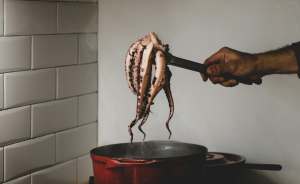
According to the BBC, the farm is designed to produce 3,000 metric tons of octopus meat annually from 1 million animals.
Nueva Pescanova is the name of the Spanish company behind what would be the world’s first commercial octopus farm.
It claims that this project is in response to rising demand for octopus meat, or pulpo, which is expected to increase by over 20% by 2028.
The company also argues that octopus farming could help conserve wild populations.
Animal rights advocates, however, strongly oppose the plan and are urging an immediate stop to the approval process. They’ve sent their petition to the Spanish government and the EU.
As of now, the project has not yet received final approval, but the debate raises broader ethical questions.
For instance, how far should we go in exploiting them for food, research, or display? Then, how well are we protecting them?
Octopuses and humans

Humans have consumed octopuses for centuries.
But before, aside from their value as food, octopuses were viewed as alien and even monstrous. They didn’t receive the love and attention, even from scientists.
These creatures were often considered terrifying, rumored to sink ships.
It’s only in the recent decades, we collectively know that the rumors and all the bad stuff we’ve been told are not true.
And after discoveries which show how intelligent they are, there’s now a relatively new movement to increase protections for octopuses.
In 2022, the British government classified octopuses as “sentient beings” under its Animal Welfare Act. The act grants them similar protections as vertebrates.
Similarly, in September 2023, the U.S. National Institutes of Health asked the public for feedback on new guidelines for improving the treatment of cephalopods in research settings.

Such concerns are appropriate for the current situation where octopuses are treated in fisheries.
According to the Food and Agriculture Organization (FAO), between 350,000 and 500,000 tons of up to 100 different species of octopuses are caught annually for human consumption.
That’s a significant rise from about 100,000 tons in the early 1970s.
Octopuses are often caught as bycatch that are not discarded due to their commercial value. But in some regions like Japan, South Korea, Spain, and Portugal, they are a primary target.
For many coastal communities, octopuses provide an essential protein source and represent a vital livelihood resource.
Current management efforts
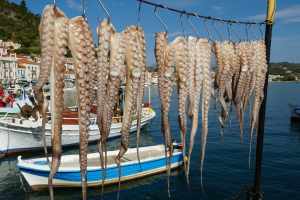
However, experts are increasingly concerned about the absence of a global management system for octopus fishing. Moreover, there’s the lack of coordinated catch limits in many parts of the world.
Unlike whales or certain fish species, we often harvest octopuses without clear data on their populations or reproductive capacity.
In some coastal regions, national or local regulations limit how frequently artisanal fishers can harvest the octopuses, or set minimum catch sizes.
However, marine biologists say that such rules are only effective when enforced, which is not always the case. Not everyone cares about the ecosystem, especially in the smaller, rural regions (speaking from experience here).
However, I must say that in some other places, local communities are managing their own fishing practices.
For instance, villagers in Tanzania’s Songosongo island have started managing the fishery collectively, as a response to the overexploitation of large blue octopus species there.
Divided opinions

To this day, the topic of octopus farming has resulted in different views.
Some scientists say that octopuses should never be kept in large numbers in small spaces because it leads to stress and overall high mortality.
Wild octopuses, they believe, have a much better life than those raised in plastic containers in farms.
On the other hand, other scientists show their support for octopus farming. They believe that this could help protect wild octopus populations and offer an additional protein source for humans.
Some noted that octopuses are well-suited for aquaculture due to their rapid growth and efficient food conversion.
Some others believe that the debate surrounding octopus farming highlights the need for a broader reevaluation.
We also know by now that pigs are highly intelligent, but we still keep them in terrible conditions.
If there’s one thing that these scientists can agree on, it’s that there’s a greater need for developing a sustainable plant-based diet and switching to that lifestyle.
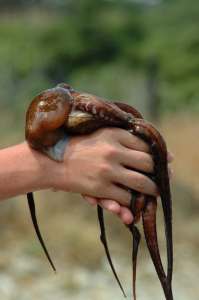
They say that relying on a fish-based diet could exacerbate pressure on marine ecosystems. And with a plant-based lifestyle, sentient wild animals like octopuses can be free to roam the oceans.
However, in an interview with an octopus expert and marine biologist Dr David Scheel, the Alaska Pacific University professor explains what both he and other scientists have learned.
Scheel admits that he no longer eats octopuses, finding them far more fascinating as living creatures than as food.
But, he recognizes that people’s choices about eating animals vary widely, influenced by culture, necessity, and personal ethics.
Octopuses and cultures or preferences
The expert argues that while octopuses are unusually intelligent, intelligence alone may not be a decisive factor in determining whether an animal should or shouldn’t be eaten.
Humans have long interacted with animals, including eating them as part of the natural order.
Therefore, Scheel doesn’t see a strict moral divide between species but instead emphasizes how interconnected life is.
“So you can’t draw a sharp line of saying, ‘Well, I would eat a clam, but I’d never eat an octopus, and neither should anyone else,’ because there’s a continuum there,” Scheel said.

The key issue, he suggests, isn’t which animals we eat but how we treat them during their lives, particularly in farming.
This particular interview unfortunately doesn’t talk about how the expert thinks of the new proposed octopus farm.
Because, I personally agree with the scientists’ opinion that it’s better to farm them than harvesting them in the wild.
That said, I don’t want to see them confined in tight spaces, as well. Because I mean, if we can farm free-range chickens, surely we can find ways to get octopus meat without abusing them, can’t we?
However, I know that octopuses are a unique animal and I’m not an expert. So I’m just stating my opinion here and I can’t give answers to how we can farm octopus ethically.
When it comes to overharvesting, Scheel is just as concerned about how easily these animals could be overexploited. Sustainable management, in his expert opinion, is important to preserve their populations.
As an example, he points to successful models of sustainable management in Madagascar. Here, local fishers periodically close off fishing areas to allow octopus populations to recover.
The interview with Scheel added another perspective about eating and farming octopuses. It also underscores the need for more thoughtful and responsible interactions with the animals humans consume.
But what about you? Do you think it’s okay to farm or eat them?
Sources:
https://e360.yale.edu/features/octopus-intelligence-conservation
Leave a Reply