


When one drives through Amman’s industrial Marka neighborhood in the east of Jordan’s capital, one won’t expect to stumble upon a flourishing forest amidst motor shops and concrete buildings.
But that’s what we’re going to find. An oasis in its early form nestled between a refugee camp and an airport.
With an area slightly smaller than a tennis court, this little haven is home to heat-resistant trees.
The trees are all native species, namely Palestine buckthorn, spiny hawthorn and Atlantic pistachio. They were carefully chosen for their ability to thrive in arid landscapes.
The masterminds behind this mini-forest are Deema Assaf, a 39-year-old Jordanian architect, and her Japanese collaborator Nochi Motoharu.
Both arranged the native species together so that the trees can grow into a dense forest within decades.
Their project, which has been taking root over the past five years across Amman, aims at several objectives.
“Our project is about many things. Making the heat more bearable, increasing the green cover, but more importantly, it is about restoring the endangered plant species that have been around for thousands and some for millions of years,” Assaf said.
It was deemed the warmest year on record in 2023. Rising temperatures caused more wildfires and melted ice sheets in Antarctica.
Now, The Middle East is home to some of the world’s hottest cities. Well, the area was and has been warming twice as fast as the global average.
Jordan was already struggling with scorching temperatures, and they wanted to find a solution.
Jordan’s hot climate
During a heatwave in August 2023, temperatures in some parts of the country reached 45C (113F).
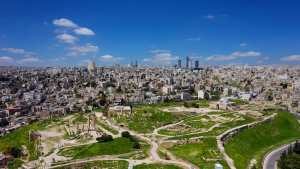
Amman, despite sitting on a plateau more than 700 meters (2,300 feet) above sea level, gets hotter each day. That’s because the city’s arid climate makes it vulnerable to global warming.
According to projections, temperatures above 45C will become common in Jordan by mid-century.
Therefore, to combat the heat, Assaf and Nochi scoured Amman for urban spaces that could be transformed into shade-providing forests.
Both have five projects completed and a sixth one, their largest, coming.
Their work is funded by the German Federal Ministry for Economic Cooperation and Development, in partnership with the local government.
The presence of trees during extreme heat may save lives.
A study published in The Lancet found that increasing tree cover in European cities could have prevented 40% of heat-related deaths in 2015.
But that’s from European cities, where the climate and landscapes are different. And admittedly, the Middle East has been underrepresented in such research.
Nonetheless, studies from other parts of the country have consistently shown that tree-covered areas are cooler. Sometimes, the effect could be as much as 12C cooler on extremely hot days.
Amman’s mini-forests, though young, already exhibit a noticeable cooling effect of about 14C under their canopies compared to open areas.
The Miyawaki method
Assaf and Nochi employ the Miyawaki method, developed by Japanese botanist Akira Miyawaki. It involves densely packing native trees to fuel rapid growth.
How does that happen? Well, when densely packed, there will be intense competition among the saplings for sunlight and soil nutrients. That leads to rapid growth.
Miyawaki developed this method during Japan’s industrial boom following World War II. At the time, many of the country’s forests and green areas were disappearing.
In a 1999 paper published in Plant Biotechnology, Miyawaki laid out the methods.
After identifying the ideal types of trees to grow, he planted two to three seedlings per square meter.
Then, he covered the ground with a mulch of organic materials such as rice straw. That aimed to prevent soil erosion and lock in moisture.
The trees were close to each other, leading to natural interactions between the species. This meant the plants only needed to be irrigated for two to three years. There was also no need for insecticides or herbicides.
On his paper, Miyawaki stated, “The site basically becomes maintenance free. Natural management is the best management.”
Doing the Miyawaki method in Jordan
Choosing the right trees for Jordan was a challenge. Compared to Miyawaki who was able to conduct field surveys of Japan’s forests, Assaf and Nochi couldn’t do that easily.
Many of Jordan’s forests were destroyed over the last few decades. Furthermore, native knowledge of the trees was lost due to urban development.
Fortunately, months of research led Assaf and Nochi to revive some of Jordan’s endangered species. The species include the evergreen and deciduous oak, wild pistachio, turpentine tree, wild pear, hawthorns and eastern strawberry.
Not only did they find which plants that thrives in Jordan without human intervention, they also fostered a mini forest.
The forest attracted various birds, butterflies, bugs, and even small animals like the fennec fox.
The residents of Marka have appreciated the positive changes.
Sami Hajj, a local supermarket owner, noted the neighborhood has had “more breeze at night.” Also, the rooftops can offer a nicer view.
The rising heat in Amman
The rising heat in Amman, intensified by more frequent heat waves, poses challenges for its residents. Tareq Quzaa, a citizen, remarks on the limited outdoor activities for children due to the scorching heat.
Well, Assaf’s mini-forest campaign aligns with Jordan’s broader efforts to adapt to a warmer planet.
Jordan’s current efforts include initiatives like green rooftops and planting 10 million trees by 2030.
However, challenges persist, and skepticism exists regarding the government’s ability to meet its tree-planting goal.
Water supply remains a significant issue, prompting efforts to build water-harvesting systems.
While Miyawaki forests offer low-maintenance solutions, the approach does have its risks.
According to Shubhendu Sharma, industrial engineer who studied with Miyawaki and now runs Afforestt, a company which plants mini forests in India, the Miyawaki method may lack complex ecosystems compared with natural forests that have matured over a few centuries.

But, Sharma doesn’t dismiss the Miyawaki method completely. “The complexity increases with time,” Sharma said.
The industrial engineer also added that forests grown with the Miyawaki method make better wind barriers and are less prone to wildfires.
Assaf acknowledges the scale of her project is small compared to the whole Amman’s land area.
Yet, she hopes it inspires action to preserve green spaces. She wishes that the project encourages the urgency of reconnecting with native ecology before it’s too late.
As the Marka mini forest opened to the public, people flocked to enjoy the green oasis. They were willing to drive up to 30 minutes for a cool breeze.
Despite its modest size, it offers a significant escape in the neighborhood, becoming a source of joy for locals and visitors alike.
source:
https://www.bloomberg.com/features/2023-amman-jordan-extreme-heat/?srnd=green
Leave a Reply