


As you may be aware, new suggestions from researchers and scientists are: the construction industry needs to be more eco-friendly.
Buildings and the materials used in their construction release a significant amount of carbon dioxide (CO2).
Storing CO2 in building materials could offer an environmentally friendly solution, and studies have shown this.
But there’s a more recent development using a composite decking material.
According to the researchers, it meets building codes and stores more CO2 than is emitted during its manufacturing process.
They claim that the carbon-negative option is less expensive than standard composite decking.
David Heldebrant, an organic chemist involved in the project, said that carbon-negative composites are rare. There are a few exceptions like cement, but they’re generally rare.

Heldebrant said that this composite could be one of the first materials to be demonstrably CO2 negative throughout its life cycle.
The construction sector accounts for 11% of all energy-related carbon emissions.
There are efforts to address this. Unfortunately, a lot of sustainable alternatives often come at a higher cost than traditional materials.
It’s either that or the alternatives lack comparable properties like strength and durability.
Timber decking itself is a well-sought construction material, representing a multibillion-dollar industry.
On the other hand, composite decking is equally popular due to its resistance to UV radiation and prolonged lifespan.
Because, composite decking is made from a mixture of wood chips or sawdust and plastic, particularly high-density polyethylene (HDPE).
One can increase the sustainability of these composites by incorporating fillers. Not just any fillers–they’re sourced from waste products or materials that would otherwise be incinerated.
Pulverized coal and composite decking
Keerti Kappagantula, a colleague of Heldebrant, was exploring a method using low-quality brown coal and lignin. It’s a wood-derived residue from papermaking, as fillers in decking composites.
The research team had to introduce ester functional groups to the particles’ surfaces. This was to ensure that the pulverized coal and lignin particles could blend with and adhere to plastics.
Heldebrant, based at Pacific Northwest National Laboratory (PNNL), discovered this approach during a casual coffee conversation with Kappagantula.
Then, when Heldebrant shared this discovery with Satish Nune, another researcher on the project, they were both enthusiastic.
Heldebrant clarified that esters act as carboxylic acids, effectively capturing CO2.

Inspired by this insight, the team aimed to incorporate CO2 onto the particles’ surfaces in the composite. This enhanced its environmental friendliness and improved its mechanical properties.
The team then utilized a traditional chemical reaction to create a new bond between CO2 and a phenol functional group.
Such a bond is abundant in wood-derived materials like coal and lignin.
Following this reaction, the lignin and coal particles contained 2–5% CO2 by weight.
Next, they blended these particles with HDPE in various ratios to produce brownish-black composites and examined their properties.
An 80% filler composite maximized CO2 content. At the same time, it met international building codes for decking materials in terms of strength and durability.

New composite decking production
Heldebrant and colleagues used PNNL’s shear-assisted processing and extrusion (ShAPETM) machine to manufacture the product.
The material was used to create 10-foot-long composites resembling standard wood composites found in decking or lawn furniture.
How was the result? Well, besides their favorable physical attributes, the new composite boards offer significant price and sustainability benefits.
According to Heldebrant, they are 18% cheaper than standard decking composite boards.
Moreover, they store more CO2 than emitted during manufacturing and throughout their lifespan.
If the 3.55 billion feet of decking sold annually in the US were replaced with the researchers’ CO2-negative composite decking, it could sequester 250,000 tons of CO2 yearly.

That’s equivalent to emissions from 54,000 cars.
The researchers intend to develop additional composite formulations and conduct property tests.
They foresee these carbon-negative composites being suitable for various building materials such as fencing and siding.
Meanwhile, the team is actively working to commercialize its decking boards. They even have plans for availability at building supply retailers as early as next summer.
Why not just recycle composite decking?
Composite decks, or WPCs, do have the advantage of diverting recyclable wood and plastic from landfills into durable building applications.
That’s why some market them as an eco-friendlier alternative.
However, one thing to note is that their “useful service life” varies depending on the product and user perception.
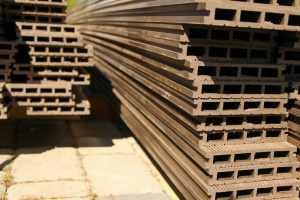
For instance, some studies suggest that typical US decking material (the deck surface) is replaced every 8 to 14 years. The reasons are usually unrelated to durability.
The most common reasons for replacement include checking and splitting of the deck surface due to cyclic wetting and drying.
Others can be attributed to poor maintenance, leading to significant aesthetic degradation that prompts users to seek replacement.
In addition, another common reason is related to remodeling or changes in deck usage patterns or design. That leads to yet another case of the need for deck surface replacement.
So, people have asked if there’s potential for even greater environmental benefit if the composites themselves are recycled. When they’ve reached the end of their service life, that is.
The thermoplastic nature of the waste materials used in WPCs makes this feasible. However, there are several challenges that may hinder recycling efforts.

Collection isn’t that easy
Collecting materials at the end of their lifespan always comes with a cost.
Figuring out how to gather this material could be a major obstacle. The diverse formulations of these composites also pose significant challenges.
Each polymer system has its own unique processing and performance characteristics. Mixing these systems during multiple recycling processes is inevitable.
While one component is recyclable, the other is better suited for composting.
The binding agent needed to create high-quality, low-maintenance decking prevents the separation of the two materials.

Unlike aluminum tins with paper labels that can be easily removed for recycling, composite materials cannot be separated. That limits options for recycling old composite decking.
Another challenge is the durability of the material.
Plastic lasts much longer than wood, that’s true. However the organic wood fibers decompose more quickly than the plastic. It can cause exposed wood fibers on the surface of the product to rot.
These factors severely limit the potential for recycling composite decking. One cannot reclaim the materials together, nor can one separate them for recycling.
Grinding or shredding composite decking, a common initial step in recycling, exposes the organic material. It weakens whatever new product is in the making from the recycled composite.
Also, old composite decking is often limited to use as filler material.
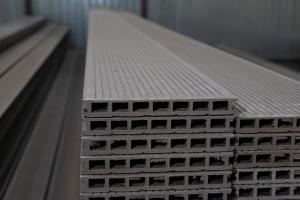
Now, there has been some success in recycling composite into items like tool trays, shutters, or rot-resistant shims.
These products are made by pressing and forming shredded composite decking and then covering it with another material for protection and appearance.
But in the end, composite currently has limited use as recycled filler material. And most of the time, that eventually leads the composites to the landfill.
In the meantime, one can enjoy composite decking for many years before eventually reaching its final resting place.
As long as WPCs replacements don’t happen before they reach their lifespan, it’s a good eco-friendly choice.
Besides, this delay allows time for significant improvements in decking recycling to be made.
sources:
https://techxplore.com/news/2024-03-composite-decking-global-effects-materials.html
Reasons and Limits to Recycling Composite Decking
Leave a Reply