


In Africa, some people are helping save rhinos in a very surprising way. They move these big animals by helicopter – and they hang the rhinos upside down while flying! It might look strange, but it works very well. This method helps protect rhinos and bring them to safe new homes.
Rhinos are large animals with horns on their heads. They are strong and heavy. Some can weigh more than 1,300 kilograms (almost 3,000 pounds). Moving them is not easy. But saving them is very important, because many rhinos are in danger of disappearing forever.
Let’s learn how experts are using helicopters to help rhinos – and why flying them upside down is actually a good thing.
Why Rhinos Need to Be Moved

In the wild, rhinos live in parts of Africa and Asia. But their homes are becoming smaller. People are cutting down trees and building farms or roads. Also, rhinos are hunted for their horns. Some people wrongly believe rhino horns are medicine or a symbol of wealth. Because of these problems, rhinos have become endangered. That means there are not many left.
In the 1990s, there were fewer than 2,500 black rhinos in the world. Thanks to the hard work of conservationists – people who protect nature – the number is now about 6,500. But that is still a small number, and rhinos need more help to survive.
One way to help them is by moving them to new places. This is called “translocation.” Rhinos are moved for several reasons. First is to protect them from hunters (called poachers) roaming around the wilderness.
Not only that, the reason they are moved is to give them more space to live and find food. It also happens to help them breed (have babies) with different rhinos so the group stays strong and healthy.
Most rhinos live in protected areas, like parks or reserves. But sometimes, those places are too small or too full. If there are too many rhinos in one place, they stop having babies as often. So moving some rhinos to new areas is a smart idea.
How Helicopters Help

Moving rhinos on the ground takes a lot of time. It is hard to drive a truck through mountains or thick forests. Sometimes, there are no roads at all. Also, road travel can stress the rhinos. They are awake during the trip and may get hurt or sick. That’s why helicopters are used.
Helicopters can fly over trees, hills, and rivers. They can quickly go from one place to another. This makes the trip shorter and safer for the rhino.
Here’s how the process works. A vet (animal doctor) flies in a helicopter and uses a dart to give the rhino special medicine. The dart is usually aimed at the rhino’s backside. This medicine makes the rhino sleepy so it does not get scared or run away.
When the rhino falls asleep (usually in 4 minutes), a team on the ground comes in. They check the rhino’s health, take blood samples, and put a small chip in the horn for tracking.
Next, the team ties soft ropes around the rhino’s feet. Then, a rope connects the rhino to the helicopter.
The helicopter lifts the rhino into the air – upside down – and flies to a safe open area where another team is waiting.
Later, the rhino is woken up and put into a new home. Some will be taken by truck from the landing area to a final location. But if that is not possible, the helicopter may fly them the whole way.
Why Upside Down Is Best
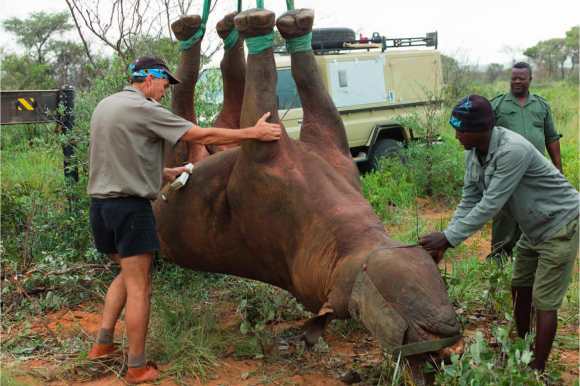
You might think that hanging a rhino upside down is cruel or dangerous. But scientists say it is actually the best way to fly a rhino safely.
Rhinos are big and heavy, but their bodies are strong. When they are upside down, they can breathe better than if they were lying on their sides. Hanging by their feet helps keep their neck and back straight. This makes breathing easier.
Also, when the rhino is upside down, its horn points down like a bird’s tail. This helps balance the rhino in the air, so it doesn’t spin around or sway too much. It creates a smoother flight.
Before choosing this method, scientists tried other ways, like putting the rhino on a board or in a net. But those ways were not as safe. Boards made the helicopter shake too much. Nets were heavy and hard to use. In the end, the upside-down lift turned out to be the safest and most efficient.
This method was even given a funny science award in 2021 called the Ig Nobel Prize. These prizes are for strange but useful research that makes people laugh – and then think.
Rhinos, Helicopters, and Optimism

The helicopters used to move rhinos have an interesting history. Some of them were used in the Vietnam War, like the famous UH-1H “Huey” helicopter. These big helicopters are strong and can carry heavy loads. Today, they are used for peace, not war – to save rhinos instead of fighting battles.
In South Africa, Namibia, and Botswana, helicopters have moved hundreds of rhinos. In just one project, the WWF Black Rhino Range Expansion Project moved over 270 black rhinos – more than half of them by helicopter. These rhinos now live in new homes where they can grow and have babies.
Of course, using helicopters is not perfect. Flying creates noise and pollution. But experts believe it is worth it to save a species that is in danger because of humans. Rhinos have lived on Earth for over 50 million years. Today, only five species are left. That’s why conservationists say we must do everything we can to protect them.
Scientists are also studying how to make these missions better. In the future, they may use drones, satellites, and even cleaner helicopter fuel to reduce harm to the environment. They are also trying this method with other animals like elephants and antelopes.
In places like Indonesia, where the Sumatran rhino is almost extinct, airlifting may become important too. The land is thick with rainforest, and helicopters may be the only way to move the animals safely.
For now, the upside-down rhino is a symbol of hope. It shows how humans can use smart ideas to fix problems we have caused. By learning to work with nature – and sometimes flipping things upside down – we can help save amazing animals for future generations.
Sources:
Leave a Reply