

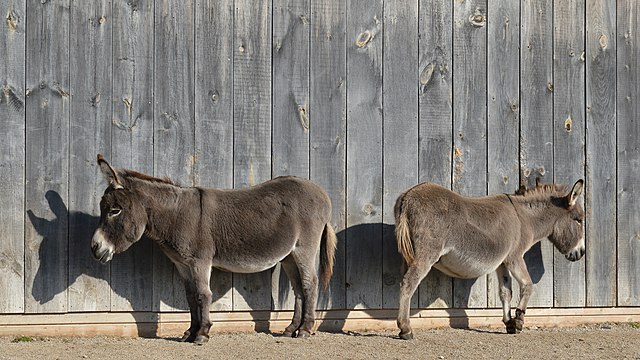
Donkeys are often perceived as ordinary work animals, but these creatures are far more intriguing than they might appear at first glance. With origins rooted in Asia and Africa, donkeys have played significant roles in human history and continue to be valued for their unique characteristics.
Beyond their reputation for stubbornness, donkeys possess remarkable traits and abilities that set them apart. Here are ten interesting facts that reveal just how special these animals truly are.
Donkeys’ Large Ears Serve a Dual Purpose
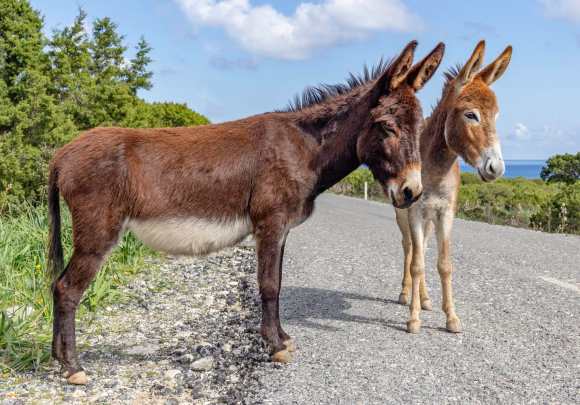
One of the most noticeable features of a donkey is its large ears, which are not just for hearing. Evolved in the arid regions of Africa and Asia, these large ears are incredibly efficient at detecting sounds over long distances, which is crucial in the wide, open landscapes where donkeys originally lived.
This acute hearing helps them stay in contact with other herd members and detect predators. But there’s more: these ears also play a vital role in temperature regulation. The broad surface area of a donkey’s ears allows for effective heat dissipation, helping them stay cool in the scorching desert heat.
Unique Vocalization
Donkeys are known for their distinctive braying, a sound that is uniquely their own among equids. Unlike horses and zebras, donkeys can produce sound while both inhaling and exhaling, which gives the bray its characteristic “hee-haw” rhythm.
The “hee” occurs during inhalation, and the “haw” happens during exhalation. Each donkey’s bray is unique, with variations in duration and frequency that can help distinguish individual animals within a herd.
This vocalization serves various purposes, including communication with other donkeys and signaling distress or excitement.
The Hairy Poitou Donkey
Among the many donkey breeds, the Poitou donkey stands out for its incredibly long, shaggy coat. Originating from the Poitou region in France, this breed was primarily developed for mule breeding. Its coat, which hangs in thick, matted cords similar to dreadlocks, makes it easily recognizable.
The Poitou’s distinctive appearance was highly prized in the past, but as the demand for mules declined, so did the population of this unique breed. By the late 20th century, the Poitou donkey was nearly extinct. However, thanks to conservation efforts and dedicated breeders, its numbers are slowly recovering.
The African Wild Ass

The African wild ass is the direct ancestor of today’s domesticated donkeys, tracing back over 5,000 years. Unfortunately, this species is now critically endangered. Despite its historical significance, only a small number of African wild asses remain in the wild, primarily due to hunting, habitat loss, and competition with livestock for scarce water resources.
Conservationists have been working to protect these animals, but their future remains uncertain. The African wild ass is a reminder of the fragility of the species that have contributed so much to human civilization.
Conservation Efforts for the African Wild Ass
In response to the dire situation of the African wild ass, international efforts have been made to conserve this species. The United Nations’ Convention on the Conservation of Migratory Species of Wild Animals developed a comprehensive plan to protect these animals, focusing on key regions where they still exist.
The plan includes legal protections in countries like Eritrea and Ethiopia and the establishment of nature reserves designed to provide a safe habitat for the remaining populations. While the road ahead is challenging, these measures offer hope for the survival of the African wild ass.
Donkeys and Hybrid Animals
Donkeys have a long history of contributing to the creation of hybrid animals due to their close genetic relationship with horses and zebras. The most famous of these hybrids is the mule, a cross between a male donkey and a female horse, which has been used as a sturdy working animal for centuries.
Other hybrids include the hinny (a cross between a female donkey and a male horse) and various zebra-donkey hybrids, known by names such as zebroids, zedonks, or zebrinny. While most of these hybrids are sterile, they have been valued for their unique traits and strength.
Social Creatures with Strong Bonds

Donkeys are highly social animals that thrive on companionship. In the wild, they form close-knit herds, and in domestic settings, they often develop strong pair bonds with other donkeys or animals they live with.
These bonds are so significant that separating a bonded pair can lead to stress, anxiety, and even loss of appetite for both animals. For this reason, it’s recommended that anyone looking to own a donkey should consider having at least two or ensure their donkey has other animals for company.
Donkeys as Guard Animals
Interestingly, donkeys can serve as effective guard animals for livestock. Their natural aggression towards canids (such as dogs, coyotes, and foxes) makes them valuable protectors of sheep and goats.
Donkeys will confront and chase away predators, and over time, the livestock they guard will learn to stay close to their donkey protector when they sense danger. This makes donkeys an invaluable asset in farms where traditional livestock guardians like dogs might not be practical.
The Truth Behind Their Stubbornness

Donkeys have earned a reputation for being stubborn, but this trait is often misunderstood. What appears as stubbornness is actually a strong sense of self-preservation. Donkeys are cautious animals that will refuse to move if they sense danger or feel unsure about their surroundings.
Unlike horses, which might bolt when frightened, donkeys prefer to stand their ground and assess the situation before deciding their next move. This behavior has been key to their survival in harsh environments and is a testament to their intelligence and instinct for safety.
Small but Mighty
Donkeys come in all sizes, but one of the most endearing is the miniature donkey. Native to the Mediterranean islands of Sicily and Sardinia, these donkeys are exceptionally small, standing no taller than three feet at the shoulder.
Despite their size, they are hardy and strong, with the same social and protective instincts as their larger counterparts. The smallest known donkey, KneeHi, measured just over 25 inches tall, but other miniature donkeys, like Ottie, have stood even shorter.
These little donkeys are beloved as pets and companions due to their manageable size and gentle nature.
Leave a Reply