

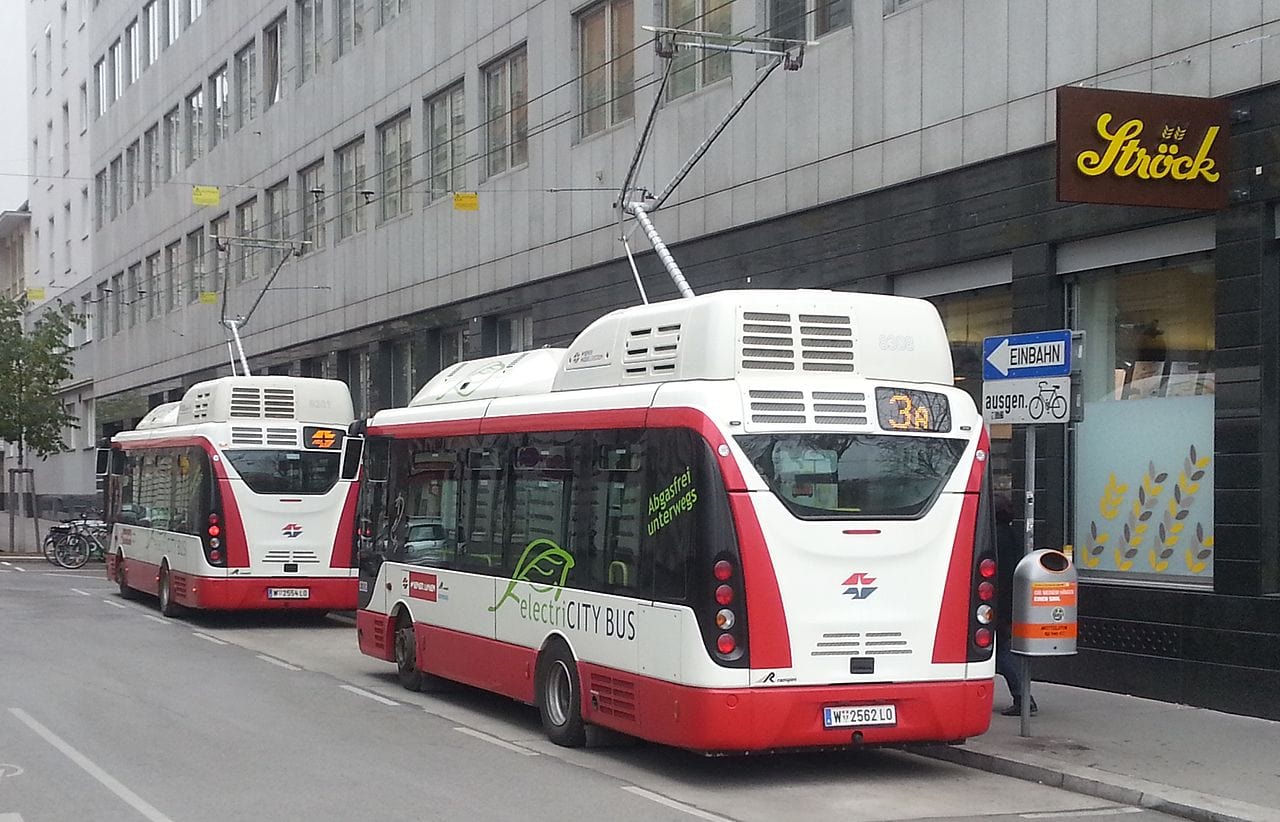
As a part of Mayor Claudia Lopez’s development plan for Bogota, La Rolita has been operating since 2022. The project, called La Rolita, is an all-electric bus fleet with a focus on gender equity. It aims to show how public investment has the ability to shift perceptions of mass transportation.
“This has been a great opportunity, and it has done a lot to change people’s view of the public transportation system in Bogota,” said Diana Ruiz, La Rolita’s bus driver.
Ruiz is just one of the many women who make up 48% of drivers on the new fleet of buses. Despite that number, data from TransMilenio, which manages the city’s public transportation system, showed that women represent just 2.8% of the city’s overall public bus drivers.
Opportunities to be electric bus drivers, entering the formal economy, are not widely available to many working class Bogotanos. This is even truer to Colombian women who, according to Ruiz, often work in the informal economy. More than half of Colombia’s workforce is made up of informal workers, so this is a good change in the country.
So, the company is working to actively bring forth equity, make the city better for its citizens, and help improve climate change.
Moreover, La Rolita has paid for its drivers, many of whom are single mothers, to upgrade their driving licenses, and enables employees to access social security, which includes a pension. Drivers make 1.7 million pesos ($376) monthly, compared to the national monthly minimum wage of 1.16 million pesos.

Public transport disenchantment
According to La Rolita’s general manager, Carolina Martinez, the Ciudad Bolivar neighborhood went more than 10 years without formal public transit after a series of deserted auctions. Martinez also thought that people have been avoiding the bus because of fare evasion and concerns about public safety.
Since the reluctance to take the bus is well established, part of the company’s challenge is to win over the public and entice them to use public transport. A 2022 annual poll by Bogotá Como Vamos found that 41% of people were unsatisfied with the city’s flagship bus rapid transit system.
Last year, the Colombia capital was 10th worst traffic congestion worldwide and it ranked second in Latin America behind Lima, according to TomTom data.
Despite the bad list, Bogota, which has no metro service and has roughly the same size population as New York City, has succeeded in reducing emissions.
It’s estimated that after launching in 2000, TransMilenio has helped to cut air pollution by as much 40% in certain areas, reduced car fatalities by 92%, and made some people (at around 11%) into giving up their cars.
Nonetheless, to give solution to the congestion problem, La Rolita has tried to focus on quality of service and community outreach. Martinez said that public transportation operators need to meet the needs of their riders, so that they’ll finally use it.
As a proof of their commitment to riders, La Rolita was quick to comply when the community asked for one of the routes to be modified.
Buses electrified
The company’s general manager also added that this fleet can meet its commitments to the public because it’s using electric buses.
Quality electric buses are equipped with advanced electrical system, scant fluids and regenerative braking. This means that there will be minimal maintenance, and in turn it’ll cost less to keep running and result in fewer service disruptions or less breaking.
Martinez said that this will make the fleet operate smoothly and sticking more closely to the schedule.
La Rolita’s 195 electric buses are manufactured by the Warren Buffett-backed Chinese company BYD. Each bus is accessible for passengers with disabilities and fitted with Wi-Fi, USB outlets, screens for public service and route information and security cameras.
As of now, there are currently 11 routes covering 210 miles (338 kilometers) of the city. Lopez has stated that the project will expand to operate along a 14-mile stretch of the iconic Carrera Septima.
The buses are charged nightly using certified clean energy from Enel Colombia, which also has a 20% stake in La Rolita. The other 80% is owned by the city, making it the first mostly public operator in decades.
When there are better bus systems, the planet will breathe more easily
Now, you may be asking, “Why are we talking about bus for improving climate change?”
Firstly, according to the US Environmental Protection Agency, transportation is the single largest source of greenhouse gas emissions, making up slightly less than 30%. While personal electric vehicles can reduce emissions, it’s not gonna make a huge dent.
Steven Higashide, director of the Clean Transportation program at the Union of Concerned Scientists, said that “electrifying personal vehicles is necessary but not sufficient.”
There are trains and other public transportation, of course, but buses are among the most overlooked solutions for decarbonization. According to data from the US Department of Defense, even gas buses reduce emissions with enough riders—although it is better if they’re powered by electric batteries.
Gas-powered buses, when ran full, would emit 0.18 pound of CO2 per passenger mile, making them comparable to rail but at a much lower cost.
But similar to Bogota, modern Americans are not too keen on taking the bus. One problem is that many people don’t live near better transit, making them rely on their personal vehicles more. An analysis by the American Society of Civil Engineers found that 45% of people in the US lack access to transit at all. Those who do live near transit find it slow and unreliable.
More often than not, buses have unpredictable cadence because of traffic and other factors, which turn people away and make them choose trains that run on fixed schedule instead.
Therefore, with plans or projects like that of Lopez’s will make people ride buses again and contribute more to slow the climate change. And in La Rolita’s case, such projects help boost economic and gender equity at the same time.

Moving towards a better city for a better environment
Bogota has been awarded a global winner of The World Wildlife Fund’s sustainability challenge in 2022. The organization applauded Lopez’s climate action plan, which seeks to reduce the city’s emissions by 15% from 2020 through next year and by 50% as of 2030, and ultimately aims to reach carbon neutrality in 2050.
Lopez’s La Rolita project is also commended by a former executive at TransMilenio and a transportation and logistics professor, Dario Hidalgo. “It’s a very good thing that one of the operators—the public operator—is placing so much emphasis on quality of service, treating people well, the fulfillment of expectations,” Hidalgo said.
How can other cities learn from Bogota? According to Higashide, when bus fleet is safe, reliable, and fast, it can feel like a public luxury instead of a last-option-out-of-desperation type of public transportation. A great bus system makes choosing transit over driving almost pleasurable rather than a sacrifice. And, it doesn’t have to be electric from the very beginning.
Sources
https://www.scientificamerican.com/article/better-bus-systems-could-slow-climate-change/
Leave a Reply