


For decades, the northwestern region of Bangladesh has played a major role in feeding the country. Vast rice fields stretch across the Barind Tract, producing millions of tons of grain each year and helping Bangladesh maintain food security for its large population.
But beneath this agricultural success, another story has been quietly unfolding underground. The region’s groundwater table has been falling at an alarming rate which creates a growing environmental crisis that now threatens both farming and long-term water security.
So, what’s the deal with this double-edged sword? Let’s talk about it.
The Water Crisis
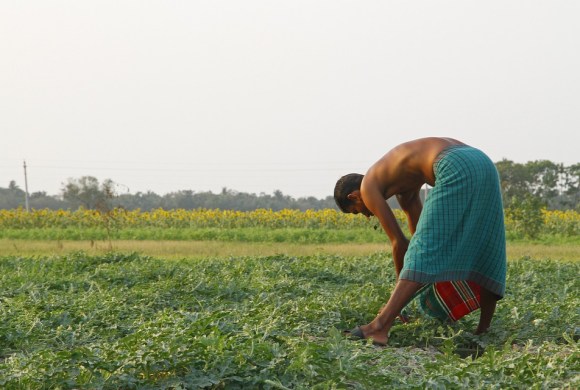
In late 2025, the Bangladeshi government officially declared 25 subdistricts in the Barind Tract as water crisis-prone areas. Officials identified excessive groundwater extraction for irrigation as one of the main causes of the problem.
In response, authorities proposed reducing cultivation of boro rice, the country’s highly water-intensive dry-season rice crop.
The decision immediately created tension between farmers, government agencies, and environmental experts because the same region suffering from water scarcity is also one of Bangladesh’s most important food-producing zones.
The situation has forced Bangladesh into a difficult balancing act. On one side is the urgent need to protect groundwater resources before they collapse entirely.
On the other side is the equally serious need to maintain rice production for millions of people who depend on affordable food and agricultural livelihoods.
The Barind Tract
The Barind Tract, located in northwestern Bangladesh, has long been known for its dry climate and lower rainfall compared to the rest of the country.While the national average rainfall reaches about 2,550 millimeters each year, the central Barind region receives only around 1,625 millimeters annually.
High temperatures, frequent droughts, and poor natural water availability have made farming difficult there for generations.
Everything began to change in the 1980s when the government introduced large-scale irrigation systems through the Barind Multipurpose Development Authority (BMDA).
The agency installed thousands of deep tube wells across the region to pump groundwater into agricultural land. The project transformed the Barind Tract into one of Bangladesh’s most productive farming zones.
Rice production expanded rapidly, especially the cultivation of boro rice, which grows during the dry season and depends heavily on irrigation. Over the past three decades, boro farming in the region increased dramatically, turning the northwest into what many experts now call the “food bowl” of Bangladesh.
Rice Giant

Today, Bangladesh produces around 39 million tons of rice annually, and boro rice contributes the largest share. The three main Barind districts alone produce roughly 1.4 million tons of boro rice every year.
This massive output has helped strengthen national food supplies and support rural economies. However, the success came with a hidden cost. Producing rice requires enormous amounts of water.
Experts estimate that growing just one kilogram of rice may require between 3,000 and 5,000 liters of water under conventional irrigation systems. Since most of this water comes directly from underground aquifers, the region’s groundwater table has continued falling year after year.
Researchers now warn that the irrigation system once praised for increasing food production has become environmentally unsustainable. Some studies describe the situation as a case of long-term overextraction, where groundwater is being removed much faster than nature can replace it.
Government’s Water Restrictions
When the government announced restrictions on groundwater-fed irrigation in late 2025, many farmers and local officials reacted with confusion and concern. The circular instructed farmers to reduce cultivation of boro rice immediately and directed BMDA to stop supplying irrigation water in the affected zones.
For many farming communities, the announcement felt sudden and alarming. Agriculture in the Barind region depends heavily on irrigation infrastructure, and millions of people rely directly or indirectly on rice farming for income and survival.
BMDA officials themselves acknowledged the difficult position. According to agency representatives, the water crisis had existed for years, but the abrupt proposal to halt irrigation created tension between authorities and farmers.
After discussions with the Ministry of Water Resources, irrigation operations were temporarily allowed to continue while the government reconsidered its approach.
Experts warn that banning rice production too quickly could create serious economic and social consequences. Around 7 million people live in the affected districts of Rajshahi, Chapai Nawabganj, and Naogaon. A sudden reduction in rice cultivation could damage local livelihoods, increase food prices, and weaken national food security.
At the same time, environmental scientists argue that continuing current irrigation practices without reform could eventually destroy the region’s water reserves entirely. Groundwater depletion not only threatens agriculture but also increases drought severity, reduces vegetation, and worsens environmental degradation across the region.
This has created a major policy dilemma for Bangladesh. The country cannot simply stop rice production overnight, but it also cannot continue extracting groundwater indefinitely without risking a larger ecological disaster in the future.
Alternative Solutions

Rather than relying entirely on rice farming, many experts believe the Barind Tract needs a gradual transition toward crops and livelihoods that require less water. In recent years, some farmers have already started experimenting with alternative agricultural systems.
Organizations such as BRAC have introduced crops like ginger, onion, garlic, potatoes, gourds, and other vegetables in drought-prone areas. These crops generally require less irrigation than boro rice while still providing farmers with reliable income opportunities.
Early results from pilot programs have been encouraging. Development workers say poor and marginalized farmers have responded positively because alternative crops can reduce water dependence while also diversifying household earnings.
Researchers are also exploring livestock farming as another potential solution. Some climate and agricultural specialists believe cattle farming for milk production could become an important source of income in the region. Grass and other natural resources in the Barind area may support livestock systems more sustainably than intensive rice cultivation.
However, experts stress that these transitions require strong government support. Farmers need access to markets, storage systems, transportation infrastructure, and financial assistance if they are expected to move away from traditional rice farming practices.
Technology may also help reduce water use without completely eliminating rice production. One promising method is called alternate wetting and drying, which allows rice fields to dry periodically instead of remaining continuously flooded. Researchers say this technique can reduce irrigation water use by roughly 30% while still maintaining rice yields.
This approach could allow Bangladesh to continue producing rice while slowing groundwater depletion at the same time. Many experts believe combining water-saving technology with crop diversification offers the most realistic path forward.
Sources:
Leave a Reply