


Oh, sorry we are not talking about one of those characters in Megaman, but the real armadillo. Armadillos are among the most distinctive and intriguing mammals, capturing the curiosity of people across the Americas.
These remarkable creatures, with their unique armored bodies, have evolved to thrive in various environments and display a range of behaviors that continue to fascinate scientists and laypeople alike.
Here in this article, we delve into some of the most interesting aspects of armadillos, exploring their species diversity, habitats, anatomy, diet, and more.
And one thing upfront, do not underestimate this animal, because it is very interesting creature.
Diverse Species of Armadillos
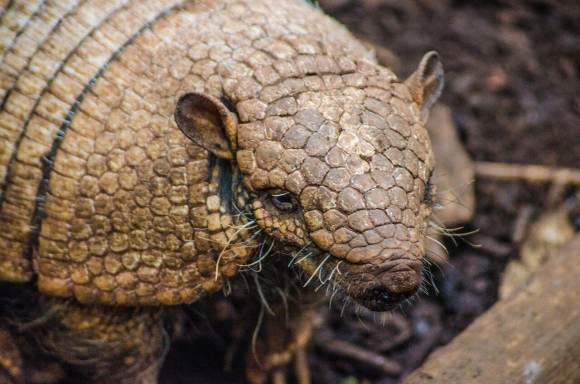
Armadillos belong to the family Dasypodidae, which encompasses 21 recognized species. Among these, the most commonly known is the nine-banded armadillo (Dasypus novemcinctus). However, this is just one of many species, each with its own unique characteristics.
For instance, the pink fairy armadillo is a small, delicate species about the size of a squirrel, while the giant armadillo can weigh up to 120 pounds, rivaling a welterweight boxer in size. Other fascinating species include the screaming hairy armadillo, the greater long-nosed armadillo, and the southern naked-tailed armadillo.
Despite their differences, all armadillos share the distinctive feature of armor plating on their heads, backs, and tails, which gives them their name—Spanish for “little armored ones.”
Habitat and Distribution
Armadillos are exclusively native to the Americas, with their origins tracing back millions of years to South America during the Cenozoic Era. At that time, South America was isolated from North America, allowing armadillos to evolve independently.
However, around three million years ago, the formation of the Central American isthmus facilitated the Great American Interchange, a pivotal event that allowed armadillos to migrate northward.
Today, most armadillo species are found in Central and South America, with only the nine-banded armadillo extending its range into North America, where it can be found as far north as Texas, Florida, and Missouri.
Anatomy: The Bony Armor
One of the most striking features of armadillos is their armor, which is made of solid bone. Unlike the keratin-based structures found in other animals, such as the horns of rhinos or human fingernails, armadillo plates are a direct extension of their vertebrae.
The number of bands on an armadillo’s armor can vary between species, ranging from three to nine. Interestingly, only one species—the three-banded armadillo—is flexible enough to curl into a ball for protection when threatened. Other species rely on different defense mechanisms, such as running away or making sudden, high jumps into the air, a behavior notably seen in the nine-banded armadillo.
Diet and Feeding Habits

Armadillos are primarily insectivores, feeding exclusively on invertebrates such as ants, termites, worms, and grubs. Their diet is a key reason for their armored bodies, which evolved more for protection from predators than for hunting.
Despite their tough exterior, armadillos are vulnerable to larger predators like coyotes, cougars, bobcats, and even birds of prey such as hawks and eagles. Interestingly, the widespread distribution of the nine-banded armadillo is partly due to its lack of natural predators, with most deaths caused by human activities, whether intentional (for meat) or accidental (such as being hit by cars).
Evolutionary Relatives
Armadillos are part of the superorder Xenarthra, which also includes sloths and anteaters. These animals are characterized by their unique spinal joints, low body temperatures, and in males, internal testicles.
This group was once more broadly classified, but genetic research led to its division into two orders: Cingulata, which includes armadillos, and Pilosa, which comprises sloths and anteaters.
Although they share some similarities with pangolins and aardvarks, these creatures are not closely related; their resemblances are the result of convergent evolution—a process where unrelated species independently evolve similar traits.
Exceptional Sense of Smell

Armadillos possess an acute sense of smell, which is crucial for locating food and avoiding predators. They are capable of detecting the scent of grubs buried up to six inches beneath the soil. This keen sense compensates for their relatively poor eyesight.
When hunting, an armadillo uses its powerful front claws to dig rapidly into the ground, a behavior that can sometimes cause problems for homeowners who may need to seek professional pest control services.
Some armadillo species are also known for their ability to hold their breath for extended periods, with the nine-banded armadillo able to remain underwater for up to six minutes.
Reproductive Quirks: Identical Quadruplets
One of the most intriguing reproductive behaviors in the animal kingdom is found in the nine-banded armadillo, which regularly gives birth to identical quadruplets. After fertilization, the egg splits into four genetically identical embryos, resulting in four offspring of the same sex.
The evolutionary reasons for this phenomenon remain unclear, but it might have originated as a strategy to reduce the risk of inbreeding or simply as an evolutionary quirk that has persisted because it posed no significant disadvantages.
Armadillos and Leprosy Research
Armadillos have an unusual connection to human medical research, particularly in the study of leprosy. These animals have low body temperatures and sluggish metabolisms, making them susceptible to the bacterium that causes leprosy, Mycobacterium leprae.
This susceptibility has made armadillos valuable in leprosy research, as they provide a viable model for studying the disease. Interestingly, the transmission of leprosy between humans and armadillos appears to have been a reverse zoonosis, where humans introduced the disease to armadillos rather than the other way around.
Leprosy was unknown in the New World until the arrival of European settlers, suggesting that the disease spread to armadillos through contact with humans.
Prehistoric Giants
Today’s armadillos are relatively small compared to their prehistoric ancestors. During the Pleistocene epoch, a period that began about 2.6 million years ago, massive mammals roamed the Earth. Among them was Glyptodon, a giant armadillo that could grow up to 10 feet long and weigh nearly a ton.
Unlike their insect-eating descendants, Glyptodons were herbivores, feeding on plants. These enormous creatures coexisted with early human settlers in South America, who occasionally hunted them for their meat and used their large, dome-shaped shells as shelters.
Sources:
Leave a Reply