

Plants are usually pretty predictable. Give them sunlight, water, and the right place to grow, and they get on with the business of being plants. But deep inside a forest in western Thailand, scientists have found a tiny flower that seems to have ignored the usual rules.
It doesn’t have the green pigment plants normally use to turn sunlight into food. It spends most of its life hidden under fallen leaves. And when it finally appears above the ground, it looks less like a normal flower and more like something from a strange fantasy movie.
Scientists have named it Thismia daemona, or the “devil flower”. But its appearance isn’t even the most unusual thing about it. This tiny plant has found a completely different way to survive.
A Flower from Horror Movie

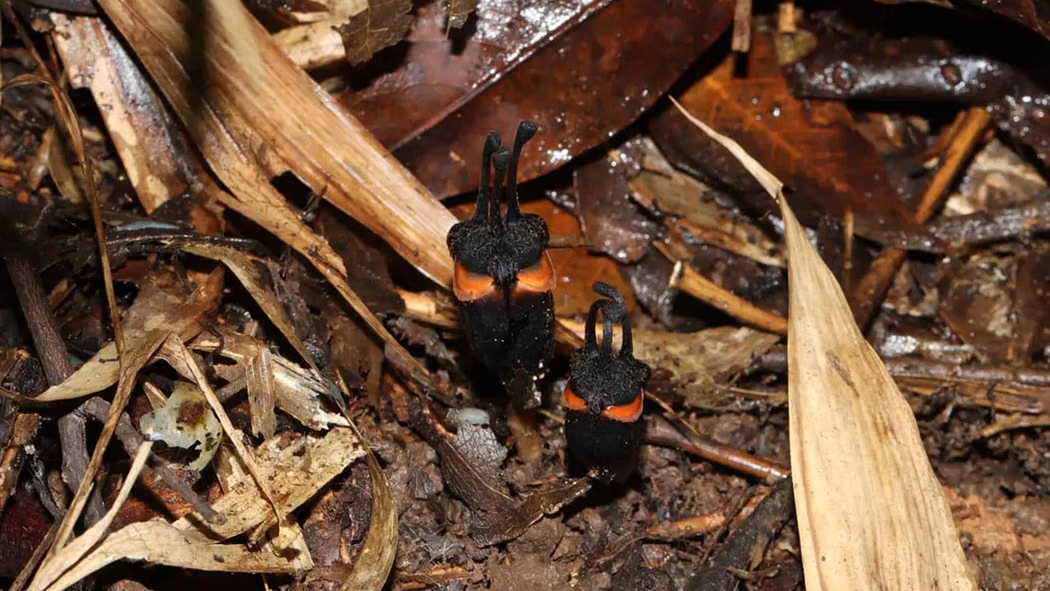
Imagine walking through a forest and looking down at the ground. Among the leaves, you notice something almost black, only a few centimeters tall. Three thin, horn-like parts stick up from its flower, while reddish-orange sections make it look as if the plant has a pair of glowing eyes.
That’s Thismia daemona.
The species was discovered in May 2025 in Thong Pha Phum National Park in western Thailand. Researchers found the plants growing among fallen leaves and small bamboo at an elevation of around 930 to 970 meters above sea level.
The plant itself can grow to about 12.5 centimeters tall, including its flower. Its roots are pale brown and covered with tiny hairs, giving them a strange appearance that researchers compared to pieces of coral.
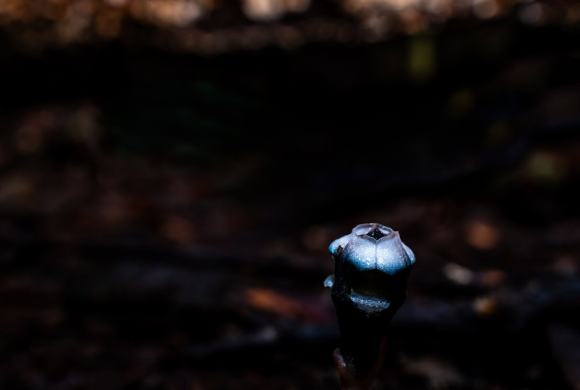
The flower is almost black, with fleshy reddish-orange sections, translucent blue stamens, and three long structures that rise above its dome-shaped top.
So yes, the name “devil flower” makes sense.
But scientists didn’t give it that name just because it looks creepy. The name also reflects the plant’s hidden lifestyle. Most of its life happens underground or beneath the leaf litter, where it can remain almost completely invisible.
And that brings us to the really strange part.
Doesn’t Need the Sun
Most plants depend on sunlight. Their green color comes from chlorophyll, a pigment that helps them capture light energy. Through photosynthesis, plants use that energy to produce the food they need to survive.
Thismia daemona doesn’t have chlorophyll.
That means it can’t carry out photosynthesis in the normal way. It can’t simply sit in a sunny spot and make its own food.
So how does it survive in the dark forest floor?
The answer is hiding beneath the soil.
The devil flower gets carbon and other nutrients through fungi that live around its roots. This unusual relationship is known as mycoheterotrophy. Instead of collecting energy from sunlight, the plant depends on an underground fungal network for the resources it needs.
Think of it as having a completely different food system from most plants.
While other plants are reaching their leaves toward the sky, T. daemona is basically relying on what is happening underground.
This lifestyle also explains why the plant spends so much time hidden. It doesn’t need to grow large leaves to catch sunlight. Instead, most of the plant remains out of sight, appearing above the ground only for a short time when it flowers and produces fruit.
That makes finding one surprisingly difficult.
Scientists Didn’t Expect to Find It There
The discovery was a surprise for another reason.
Species in the Thismia group are generally associated with very humid rainforest environments, often at lower elevations. But T. daemona was found in a seasonal mountain forest nearly 1,000 meters above sea level.
Sahut Chantanaorrapint, a botanist from Prince of Songkla University, said finding the species was a major surprise.
The discovery suggests that plants in this group may be able to survive in a wider range of environments than scientists previously thought.
Researchers didn’t simply look at the flower and decide it was a new species. They examined its physical features using microscopes and high-resolution photographs. They also studied several parts of its DNA and compared them with other Thismia species.
The closest known relative appears to be Thismia betung-kerihunensis, a species found in Borneo.
The discovery also changes what scientists know about the distribution of this unusual plant group. T. daemona belongs to a smaller group called Geomitra. Before this discovery, members of that group had only been recorded in Peninsular Malaysia, Borneo, and Sumatra.
Finding one in western Thailand extends the known range farther north.
It also brings the number of recognized Thismia species in Thailand to 16.
That’s a pretty big scientific discovery for something that can easily be missed beneath a pile of leaves.
Already in Trouble
There’s one problem, though. Scientists have found only one population of Thismia daemona, and it contains fewer than 50 plants.
The entire known population occupies an area smaller than 0.05 square kilometers.
That makes the devil flower extremely vulnerable.
The plants are inside a protected national park, which gives them some protection from development. But the area is also visited regularly by tourists. Someone walking along a forest path could accidentally step on the plants or disturb the fragile layer of leaves and soil where they live.
And because the plant depends on fungi underground, protecting the flower means protecting its whole little world.
The researchers have therefore given the species a preliminary assessment of Critically Endangered under IUCN criteria. That doesn’t mean it has officially been added to the IUCN Red List yet, but it shows just how limited its known population is.
This is also a reminder that discovering a new species doesn’t always mean finding something in some untouched jungle thousands of kilometers from civilization.
Sometimes, nature’s strangest secrets are sitting right under our feet.
The devil flower is tiny, dark, and easy to overlook. It doesn’t need sunlight like most plants, and it spends much of its life hidden from view. Yet its discovery has given scientists a new clue about how unusual plants can survive and where they might be hiding.
It also shows why protecting forests isn’t only about saving the big, famous animals. Sometimes the smallest organisms depend on very specific places, relationships, and conditions. Lose that little piece of the forest, and a species we have only just discovered could disappear before we even understand it.
For now, Thismia daemona remains one of those rare reminders that the natural world still has plenty of surprises waiting beneath the leaves.
Sources:
Leave a Reply