

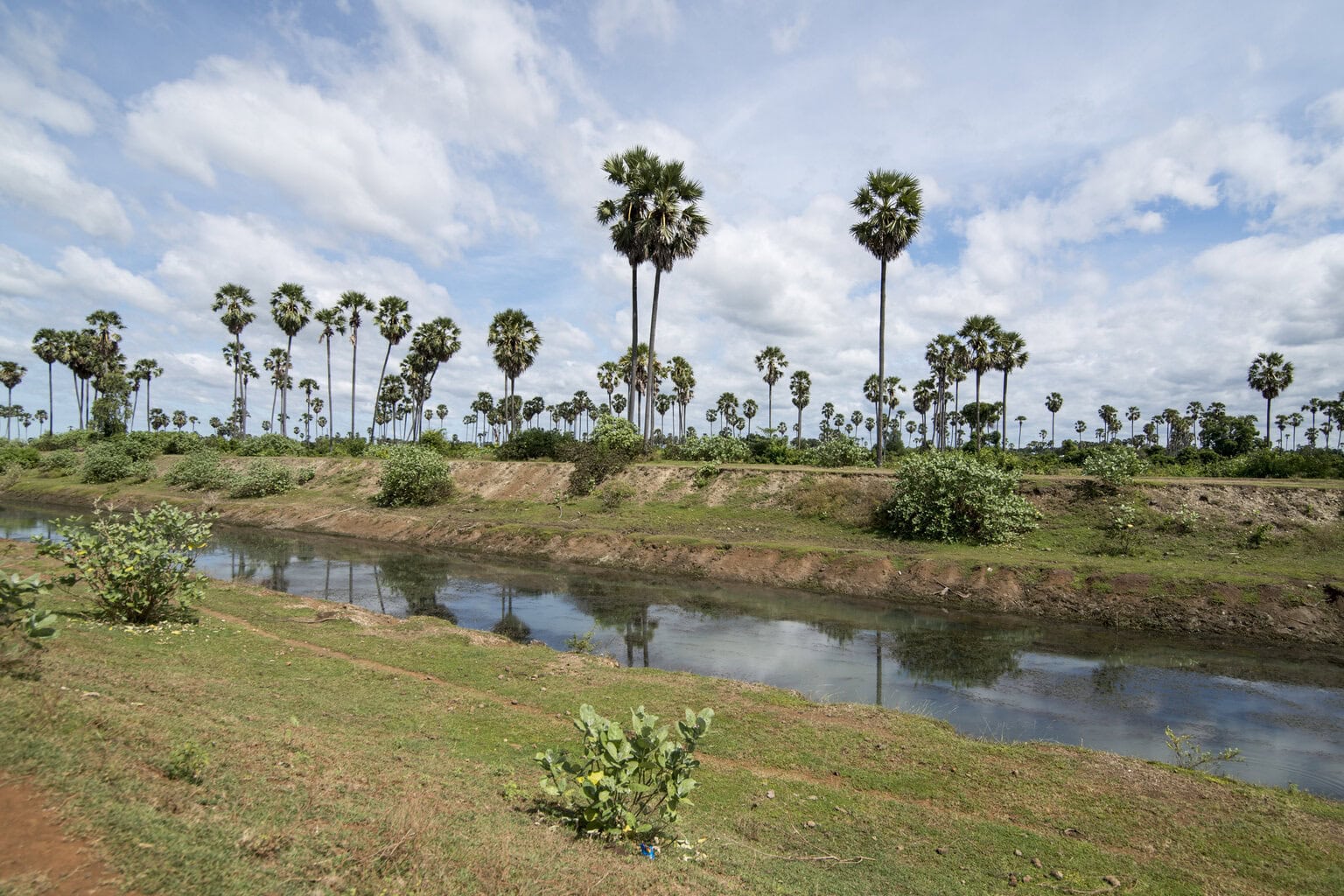
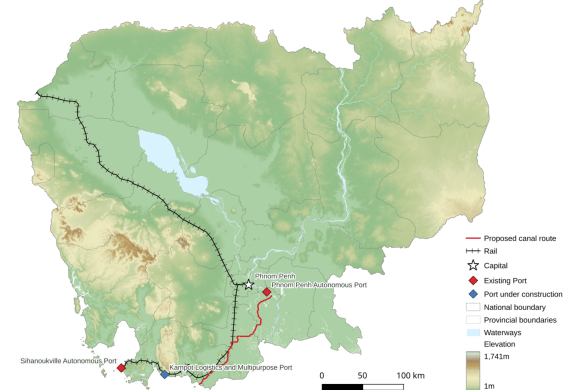
In August 2024, the Cambodian government held a celebration. There were balloons, flag-waving, and powder cannons to mark the groundbreaking of the Funan Techo Canal, a nearly $1.2 billion waterway that would cut 180 kilometers through four provinces to connect the Mekong River to the sea.
Officials spoke of economic growth, job creation, and reduced shipping costs. But for the thousands of farmers and fishing communities living along the canal’s planned route, the celebration marked the beginning of something far less festive.
It was a prolonged, suffocating uncertainty that, by early 2026, still showed no signs of ending. So, why should we talk about it? Find out here.
The Conversation
Mongabay spent more than a year reporting along the canal’s route, speaking with over 50 residents across Kandal, Takeo, Kampot, and Kep provinces. What emerged from those conversations was not a picture of a community bracing for progress. It was a picture of people left completely in the dark.
Thet Chanton had just finished building his new home along the banks of the Prek Bassac in Takeo province when local authorities told him it would have to come down. He had taken out a $10,000 microfinance loan to help cover the $20,000 construction cost.
Five months after moving in, he was told the canal would likely swallow his house, his rice fields, and everything else he owned.
“The government should have been clear with people,” Chanton told Mongabay. “We need to know where the canal will be built, where we will go after it’s done, how we will be compensated and so on. Instead, more than 100 households in this area have to live with these worries every day.”
The government estimated that 400 households would lose their homes entirely, with 2,305 households and roughly 11,525 people affected in some way. But those numbers offered little comfort to the people behind them, because no one was telling them what came next.
The Return
Mongabay returned to these communities in April 2025 and again in October 2025. In virtually every case, the situation had not changed. Residents still had no information about relocation packages, compensation amounts, or construction timelines. Even elected local officials said they had received nothing.
Keo Sarath, a village chief in Kok Nuer village, Takeo province, told Mongabay he had repeatedly asked for details and received none. He knew that 62 households in his village would be directly affected by the canal, but that number only counted houses. Far more people farmed land in the area without living on it.
“From what I’ve seen of the Funan Techo Canal, it’s only created problems for people,” Sarath said. “It’s a lot of time, money and energy to start a new life in a new place. It feels like a waste of our village.”
Between October 2024 and February 2026, Mongabay repeatedly attempted to contact government officials about the project, including delivering written questions directly to the office of Deputy Prime Minister Sun Chanthol, who leads the canal initiative. None responded.
By January 2026, some residents had received partial updates. Chea Huot, another Takeo resident who had spent more than a year fearing eviction, learned that the canal’s route had been adjusted slightly and his house would be spared.
But the relief was narrow. He noted that while fewer houses appeared to be in the canal’s path after the rerouting, a large amount of farmland had been affected instead.
The Impact
The disruption facing communities along the canal’s route went beyond displacement. Even farmers who would not have to move worried about what the construction would do to the land and water they depended on.
The Funan Techo Canal was designed to cut east to west across the Mekong’s floodplains. But floodwater in this region moves north to south.
An analysis by the Stimson Center, a U.S. think tank, found that the canal’s levees would interrupt that natural flow, leaving communities south of the canal deprived of water while those to the north faced increased flooding.
The government had not released an environmental impact assessment or detailed engineering plans, making it impossible for outside analysts to assess the full consequences.
Brian Eyler, director of the Stimson Center’s Southeast Asia program, told Mongabay in October 2025 that no flood mitigation infrastructure had been included in the publicly available designs to allow water to pass through the canal and sustain critical wetland habitats during the wet season.
One of those habitats was Boeung Prek L’pov, a protected wetland covering 8,300 hectares near the Vietnamese border.
Around 6,000 people depended on its annual three to four months of flooding to plant rice, fish, crab, and raise livestock, activities collectively worth an estimated $2.1 million per year. The wetland also supported at least 102 bird species, including the critically endangered Bengal florican and yellow-breasted bunting.
Documents submitted to the Mekong River Commission by the Cambodian government showed only three sluice gates planned for the entire canal, which conservation experts said was far too few to prevent a severe reduction in water flow into Boeung Prek L’pov.
The Canal

The Funan Techo Canal was conceived as an infrastructure project to serve Cambodia’s economy. Its primary purpose was to reduce the country’s dependence on shipping routes through Vietnam, which currently handled roughly one-third of Cambodia’s imports and exports.
The government hoped the canal would eventually support 90% of the country’s trade flows and generate between 50,000 and 1.6 million jobs by 2050.
But the economic case for the canal existed alongside a human cost that the government had done very little to account for publicly. Rights group Licadho had estimated that 734,000 Cambodians were displaced by land-grabs between 2000 and 2023.
The Funan Techo Canal looked set to add to that number, with residents like Kaem Sreng, a farmer in Pu Kandal village, describing the daily psychological toll of waiting without answers.
“I feel sick every day since the authorities came to interview me,” Sreng told Mongabay. “I’m sick with worry.”
In February 2026, a government spokesperson was quoted saying the construction company had declined to begin work until all issues with affected communities had been resolved. The canal, the spokesperson added, may be completed in 2028.
For the thousands of people still waiting along its route, that timeline offered no clarity about what they stood to lose, or what, if anything, they would receive in return.
Sources:
Leave a Reply