


Most flowers fit comfortably in a hand. They bloom for a few days, attract a bee or two, and fade without much drama.
But scattered across rainforests, mountain highlands, Mediterranean seafloors, and North American plains, a small number of flowering plants had pushed the boundaries of size so far that they barely resembled what most people thought of as a flower at all.
Some smelled like rotting corpses. Some lived for hundreds of thousands of years. Some took nearly a century to produce their first bloom. The world’s biggest flowers were not just large. They were, in almost every case, deeply strange.
What are they?
The Giants
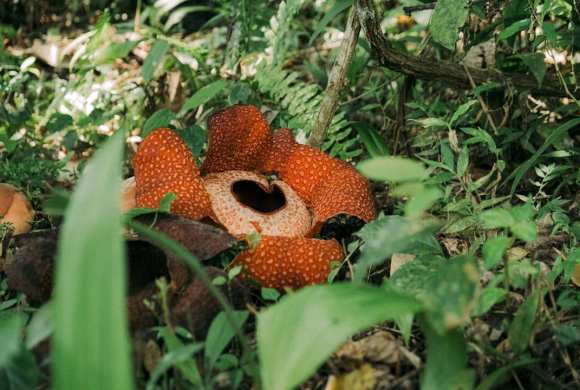
Botanists working in tropical rainforests encountered some of the most dramatic examples. In the rainforests of Malaysia and Indonesia, researchers had long known about Rafflesia arnoldii, a plant that produced the largest single bloom of any flowering species on Earth.
A single flower could reach three feet in diameter and weigh up to 15 pounds. It had no leaves, no stem, and no roots of its own. It lived entirely as a parasite inside the tissues of a specific vine, the Tetrastigma, and became visible only when it pushed through the vine’s surface to flower. The bloom lasted just a few days before rotting away.
To attract the flies that pollinated it, Rafflesia produced a powerful smell of decaying meat, which earned it the nickname “monster flower” and occasionally the name “corpse flower.” That second name was also claimed by another giant, Amorphophallus titanum, native to Sumatra.
Unlike Rafflesia’s single massive bloom, Amorphophallus produced an inflorescence, a structure made up of hundreds of tiny flowers clustered on a single stalk that could rise ten feet into the air. It too released the smell of rotting flesh to attract pollinators. The two plants were unrelated but had arrived at the same strategy through entirely separate evolutionary paths.
Another Case in Amazon
When researchers tried to understand how plants had developed such extreme sizes, they found that the answers were rarely simple. Size, in flowering plants, had evolved for different reasons in different lineages, and the pressures that drove it varied widely depending on where the plant lived and what it needed.
The corpse flower’s towering inflorescence, for example, concentrated heat in its central structure during bloom, helping to spread the rotting smell further and attract more flies from a greater distance.
Rafflesia’s enormous single flower provided a large surface area that mimicked the look and smell of meat, making the deception more convincing to the insects it needed.
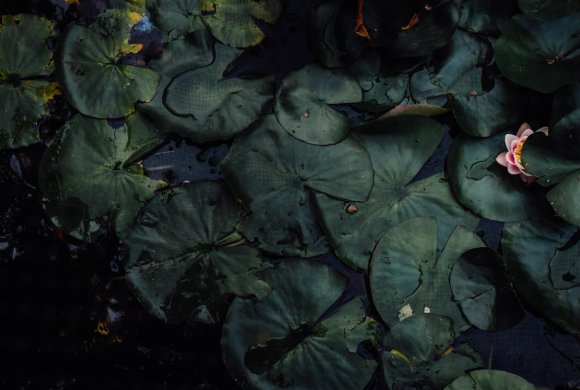
The Amazon water lily, Victoria amazonica, had developed its size for different reasons entirely. Its pads grew up to eight feet in diameter in the still, warm waters of South American rivers and lakes, and the sheer size gave it a competitive advantage.
The sharp spines on the underside of the leaves defended against fish that might graze on them from below, while the pads themselves spread outward to block sunlight from rival plants, clearing space for further growth.
The flowers, which appeared only at night and lasted just a few days, were the size of a soccer ball and produced a pineapple-like scent that attracted specific beetles. They opened white on the first night, changed to pink or red on the second, and then closed permanently.
Floral Deception
Not all of the world’s biggest flowers used scent as their primary strategy. Some had developed through a logic of time rather than smell, storing energy across decades before producing a single spectacular display.
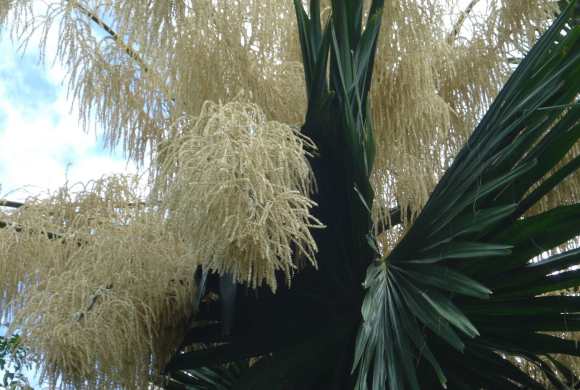
The Talipot palm, Corypha umbraculifera, grew for roughly 80 years without flowering. Then, at the end of its life, it produced an inflorescence between 19 and 26 feet long, covered in millions of tiny blooms arranged in branching clusters that looked like enormous golden fans sitting atop an 80-foot trunk.
After flowering, the tree died. The entire reproductive effort of a lifetime was concentrated into one final display.
The Queen of the Andes, Puya raimondii, followed a similar pattern. Growing in the highlands of Peru and Bolivia at elevations above 13,000 feet, it spent between 80- and 100-years building energy before sending a flower stalk 30 feet into the air carrying thousands of individual flowers and up to 12 million seeds.
Then it too died. A bromeliad related to pineapples and other tropical plants, it was classified as endangered by the IUCN due to damage from cattle grazing, fire, and climate change.
The sunflower, Helianthus annuus, took a more familiar approach, but even within the familiar there was surprising scale. Given adequate sun and water, the common sunflower could grow to 30 feet tall.
Its head was itself an inflorescence, containing anywhere from 13 to 30 ray flowers around the outside and hundreds or even thousands of smaller disc flowers in the center. Domesticated in the Americas around 1,000 B.C., it was one of the few giant flowering plants that had become a major global crop.
Impressive in Their Own Ways
Some of the most extraordinary flowering plants on Earth were not impressive because of what a single bloom looked like, but because of what the plant had become over geological time.
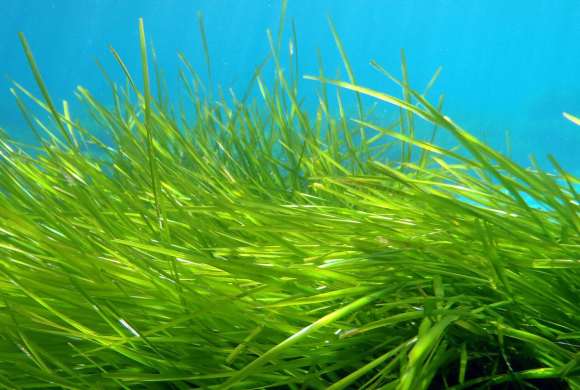
Posidonia oceanica, a flowering grass that grew on the floor of the Mediterranean Sea and off the coast of Australia, had developed into colonies that were among the oldest living organisms ever documented.
A single colony discovered in the Mediterranean in 2006 was several miles wide and estimated to be hundreds of thousands of years old.
It covered roughly 15,000 square miles across the Mediterranean basin, absorbed and stored significant amounts of carbon dioxide, and produced seeds through conventional flowering reproduction.
It was also threatened by rising water temperatures driven by climate change.
Pando, a clonal colony of quaking aspen in Utah, told a similar story from the land. Though aspen trees were not known for dramatic blooms, the colony itself represented one of the most staggering living structures on Earth.
More than 47,000 individual trunks had grown from a single root system covering 107 acres, estimated to weigh 13 million pounds and to be more than 80,000 years old. Every trunk was genetically identical, making the entire forest effectively one organism.
Taken together, the world’s biggest flowering plants pointed to how far a single evolutionary innovation, the ability to attract animals for pollination through color and scent, had been pushed over hundreds of millions of years of adaptation.
Size, in flowering plants, had not developed in a straight line. It had branched in dozens of directions, each shaped by the specific pressures of a particular environment, producing results that continued to surprise the scientists who studied them.
Sources:
Leave a Reply