

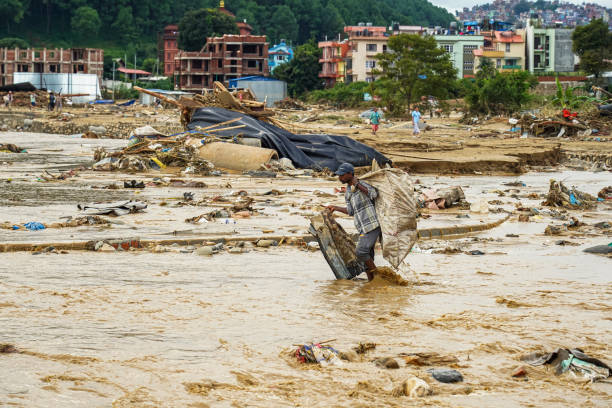
On Wednesday, August 26, a sudden flood tore through Nepal near the Tibet border and left dozens dead and hundreds missing. At first, an earthquake was suspected.
Then scientists looked more closely at satellite images and found something very different. Part of a glacier had apparently broken away high in the mountains and sent ice, rock, and debris crashing into the valley below.
The disaster has killed at least 170 people, with hundreds more still missing. And while scientists are still working out exactly why the glacier collapsed, they already know the bigger story is becoming harder to ignore.
The Shrinking Glacier
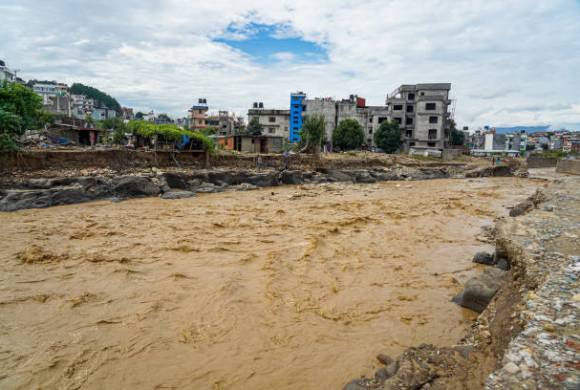
The glaciers of the Hindu Kush Himalaya are shrinking faster, the mountains are warming, and communities downstream are facing a growing risk from the changes happening high above them. And that’s something we surely have to talk about.
At first, people thought an earthquake had triggered the disaster. It was an understandable guess, since the event was powerful enough to register seismic energy, and the flood that followed was enormous.
But the U.S. Geological Survey later clarified that the signal was not a normal earthquake. It came from the collapse of glacial rock and ice, followed by a huge debris flow.
Satellite images from Planet Labs showed the mountainside had gone from green and snow-covered to buried under brown sediment and debris.
Dan Shugar, an earth scientist at the University of Calgary, said the lower part of a glacier appeared to have broken away at around 5,200 meters above sea level and crashed onto the valley floor roughly 1,200 meters below.
Vikram Gupta, a geology specialist at India’s Sikkim University, also confirmed a substantial part of the glacier’s lower section had collapsed and probably carried rocks and sediment with it.
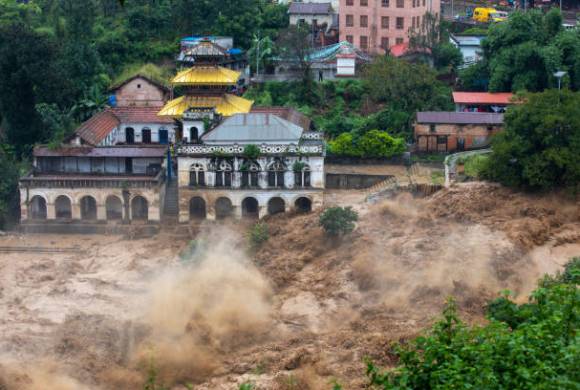
The material entered the Lende Khola, a tributary connected to the Bhote Koshi river system, and the flood became a moving wall of water, mud, ice, and huge rocks.
ICIMOD, the International Centre for Integrated Mountain Development, described it as an ice-rock avalanche and found that river levels downstream rose by as much as seven to nine meters within only 30 minutes.
Imagine watching a normal river suddenly rise several meters before you can even react. That’s what made this disaster so deadly.
The Mountain
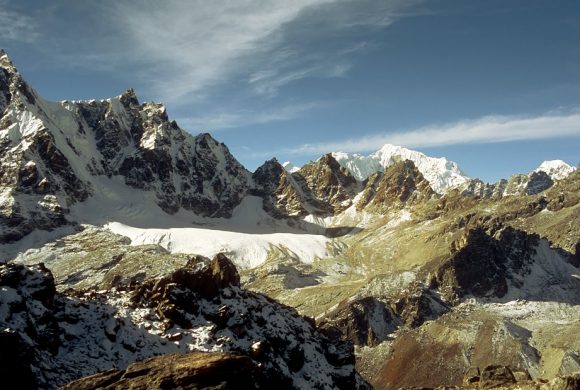
Scientists cannot yet say exactly why the glacier broke apart, but there may have been several things happening at once.
Shugar noted that satellite images appeared to show a large amount of snow disappearing from the glaciers in the 24 hours before the flood, which suggested the area may have experienced a warm spell shortly before the disaster.
But temperature is only part of the story. Mike Searle, a professor of earth sciences at Oxford University, explained that the Himalayas are still rising because of the ongoing movement of tectonic plates.
He compared the process to putting a jack under a car and slowly lifting it. As mountains rise, their slopes become steeper, and glaciers sitting on those slopes can become unstable too.
In this case, scientists believe a much larger section may have collapsed almost at once. The steep valleys surrounding Langtang Lirung, the mountain near the suspected collapse, then made things worse.
They act like giant channels and force water and debris to move rapidly downhill. So you have several ingredients coming together: steep mountains, unstable ice, loose rock, melting snow, and a river valley ready to funnel everything downstream.
Scientists are careful not to say climate change directly caused this one event, since a single collapse can have many possible triggers. But a warmer climate is changing the conditions in which these events happen.
Bigger Glacier Problem Is Already Here

The Nepal disaster becomes even more worrying when you look at what’s happening across the wider Hindu Kush Himalaya.
According to ICIMOD’s 2026 glacier reports, glaciers across the region are now losing ice at twice the rate seen since 2000. Between 1990 and 2020, the region lost about 12% of its glacier area and around 9% of its estimated ice reserves.
Since 1975, some glaciers have lost up to 27 meters of ice thickness. The smallest glaciers are disappearing fastest.
Sudan Bikash Maharjan, a remote sensing analyst at ICIMOD, said glaciers smaller than 0.5 square kilometers are shrinking more rapidly than larger ones, and about three-quarters of the region’s glaciers fall into this vulnerable group.
That matters because glaciers aren’t just pretty white mountains in the distance. They are natural water storage systems. The Hindu Kush Himalaya contains more than 63,700 glaciers.
They feed at least ten major Asian river systems and provide water for nearly two billion people downstream. So when the ice changes, your problem isn’t limited to the mountain.
You can get too much water in one moment and less reliable water later. Pema Gyamtsho, director general of ICIMOD, has warned the region is reaching a critical period where water uncertainty and disasters are becoming harder to ignore.
And scientists still don’t have enough eyes on the mountains. ICIMOD found that only seven of 38 monitored glaciers meet global monitoring standards, and large areas remain poorly monitored.
One Flood Is a Warning
The Nepal disaster is not happening in isolation. Scientists have seen glacier collapses, landslides, and glacial lake floods in places including India, Switzerland, and Italy.
In 2021, a glacier collapse in India’s Chamoli region triggered a deadly flood that killed around 200 people.
Mohd Farooq Azam, a cryosphere specialist at ICIMOD, said the increasing frequency of hazards in the frozen parts of the Earth is becoming more visible than ever, and the pace of change is extremely rapid.
Dr Simon Cook, a glacier expert at the University of Dundee, pointed to the wider climate connection. As temperatures rise, glaciers shrink, snow melts, and permafrost, frozen ground that helps stabilize mountain slopes, can thaw.
When it weakens, rocks and slopes become more unstable. That doesn’t mean every flood is caused by climate change. But it means the background conditions are changing.
For you, the lesson from Nepal isn’t simply that glaciers can collapse. It’s that the mountains are becoming a different kind of risk.
The Hindu Kush Himalaya may look enormous and unchanging from a distance, but its ice is moving, shrinking, and sometimes breaking apart with devastating consequences. Better monitoring can give communities more warning.
When the ice moves, the effects can travel a very long way.
Sources:
Leave a Reply