

Isn’t it kind of funny how something as simple as underwear can end up teaching scientists about the health of an entire country’s soil? Picture this. You bury a brand new pair of cotton underpants in your backyard, wait two months, then dig it back up expecting, well, underwear.
Instead you find something that looks more like a spider web than actual fabric. That’s exactly what happened to scientists in Switzerland, and no, this wasn’t some prank gone wrong. It was actual, serious science.
Researchers buried more than 2,000 pairs of cotton underwear across gardens, meadows, fields, and lawns all over Switzerland, and the results ended up revealing way more about our soil than anyone expected.
Welcome to the world of the “Underpants Index,” a study that sounds ridiculous on paper but is honestly one of the smartest ways scientists have found to get people to care about the ground beneath their feet. Let’s check this out.
Why On Earth?!
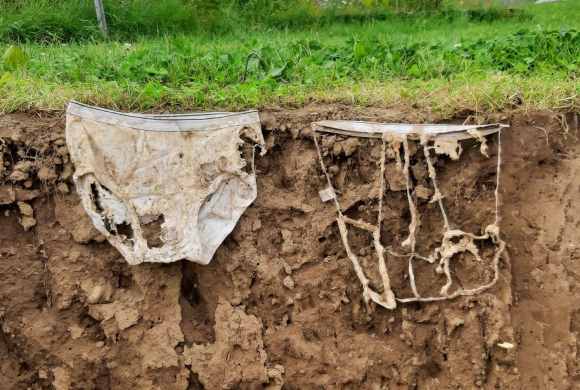
You might be wondering why anyone would choose underwear of all things for a serious scientific study. Turns out, it’s actually genius. Cotton breaks down naturally when it’s surrounded by healthy, active soil life, so the more holes and tears your buried underwear develops, the more biologically active your soil actually is.
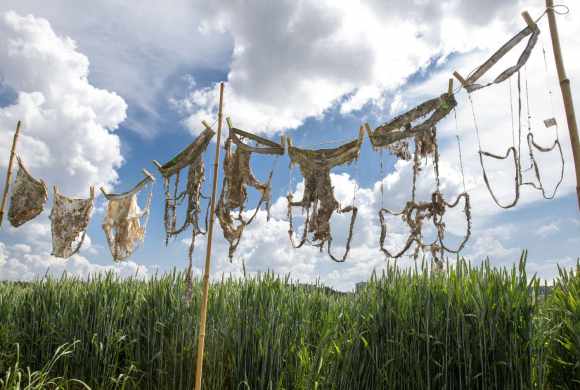
When researchers dug up their buried undies two months later, some pairs had basically disintegrated into nothing but seams, while others still had most of their shape with just a hole or two.
The study, published in the journal Plants, People, Planet and led by scientists at the University of Zurich, found that underwear works surprisingly well as what the researchers call a simple and easy to interpret tool for understanding soil health.
It’s playful, it’s cheap, and honestly, it grabs attention way faster than handing someone a soil pH chart ever could.
And attention is exactly what soil needs right now. Beneath our feet, topsoil quietly provides 95 percent of the food we eat and hosts 59 percent of the planet’s biodiversity, making it the second largest carbon reservoir on Earth after the oceans themselves.
Without healthy soil, the whole foundation of our food system basically collapses, yet most people walk right over it every single day without giving it a second thought.
What Your Backyard Says

Here’s where things get genuinely surprising. Land use turned out to be the single biggest factor in how fast the underwear broke down, even more important than other soil characteristics researchers measured.
Lawns, croplands, and grasslands showed the lowest signs of biological activity across the board, with monocultured grass lawns, the kind that wrap around most houses and buildings, coming out as the least fertile soil type of them all.
Private gardens, on the other hand, told a completely different story. These spaces hosted the most active decomposers around, think worms, fungi, bacteria, and all sorts of other soil dwelling organisms working overtime.
About 58 percent of the buried cotton fully decomposed in private gardens within just two months, compared to only around 40 percent in lawns.
According to agroecologist Marcel van der Heijden, co-leader of the study at UZH, how we manage soil can seriously affect both soil life and soil quality, and healthy, biologically active soil is crucial for fertility, nutrient cycling, and a whole bunch of other ecosystem services we tend to take completely for granted.
Makes sense when you think about it. Gardens get fertilized, watered, and aerated regularly by their owners, so it’s basically like giving your soil a personal trainer while your lawn just sits there doing its own thing.
More Nutrients Isn’t Always Good
Now here’s the twist nobody saw coming. You’d think more decomposition automatically means healthier soil, right? Not exactly. It’s kind of a double edged sword. Private gardens did show higher levels of phosphorus, nitrogen, and potassium, which are clear signs of fertilizer use, but too much of a good thing can actually backfire in a big way.
In fact, phosphorus levels in many private gardens far exceeded the recommended thresholds for soil management and crop production, which could end up threatening nearby waterways and local biodiversity instead of helping it.
According to co-project leader Franz Bender, an agroecologist involved in the study, maximum decomposition isn’t actually desirable in every single ecosystem. In near natural habitats like forests, extremely high nutrient levels can actually signal that something’s off balance rather than something thriving.
So basically, the Underwear Index can tell researchers which soils are the most fertile, but figuring out which ones are actually the healthiest requires a whole lot more digging, pun fully intended.
Global Fashion Statement

This entire project wasn’t just a one person experiment either. Around 1,000 volunteers came together five years ago to bury both cotton underwear and roughly 12,000 tea bags across Switzerland’s varied landscapes, and both items ended up telling researchers a very similar story, decomposing fastest in private gardens every single time.
Interestingly, a separate citizen science project in Hungary found the exact same pattern with underwear decomposing quicker in managed kitchen gardens too, which basically confirms this isn’t just a Swiss fluke.
Bender himself admitted this project turned into one of the most intense yet most rewarding experiences of his entire scientific career so far, and honestly, it’s easy to see why.
This quirky little experiment has quietly built one of the most comprehensive datasets on soil life in the entire country, all thanks to a bunch of buried underwear nobody expected to matter this much.
So next time you’re gardening, mowing your lawn, or just walking across a grassy field somewhere, maybe give a little thought to what’s actually happening underneath your feet.
Who knew that the secret to understanding our planet’s health was hiding in something as simple, and as slightly hilarious, as a pair of old cotton underwear buried in the dirt.
Sources,
Leave a Reply