

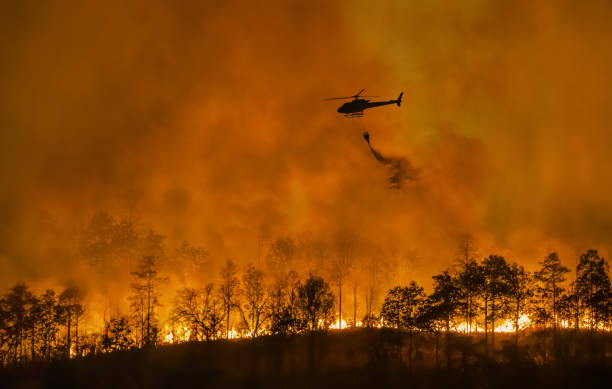
If you live near a forest or peatland in Kalimantan (Borneo), you may be watching the horizon for signs of another fire. That is the reality facing parts of Indonesia right now.
Forest and land fires are spreading across several provinces, while smoke from West Kalimantan has already crossed into Malaysia. Authorities are sending thousands of people, helicopters, and other resources to fight the flames.
But with a strong El Niño making conditions drier, the fire season could become much harder to control.
The Fires Are Growing

Indonesia’s fire season usually becomes most dangerous around August and September, when dry weather makes forests, grasslands, and peatlands easier to burn. This year, however, fire activity was already rising before the peak arrived.
West Kalimantan has been hit particularly hard. According to Indonesia’s disaster management agency, BNPB, about 28,680 hectares had burned there by August 9.
That’s more than half of the 48,889 hectares burned across six priority provinces. Madani Berkelanjutan, an Indonesian environmental group, reported an even larger figure, estimating that 50,558 hectares in West Kalimantan showed signs of burning.
The increase happened quickly. Across Indonesia, the area identified as burned jumped from about 15,474 hectares in June to 124,040 hectares in July. That’s roughly eight times more in just one month.
Satellite data is sending another warning. FireWatch, a monitoring platform developed by Nusantara Atlas, detected more than 96,000 fire hotspots across Indonesia by July 27. By August 11, that number had passed 154,000.
For comparison, about 88,000 hotspots had been recorded by late July during the major 2019 fire season, while around 58,000 were recorded at the same point in 2023.
So this isn’t simply another dry season with a few fires here and there. The scale is already becoming difficult to ignore, and August and September are still ahead.
The Smoke Is Crossing Borders

A forest fire doesn’t need a passport, and neither does its smoke. Fires in West Kalimantan have sent haze across the border into Sarawak, Malaysia.
On August 12, the air pollution index in Tebedu, near the Indonesian border, went above 200. That’s considered a very unhealthy level.
The impact was immediate. Six schools in Sarawak moved their classes online because of the poor air quality. Kuching, the capital of Sarawak, was also ranked by IQAir as the world’s most polluted major city on August 11.
Eleven areas across Sarawak recorded unhealthy air quality readings that day. Indonesia is dealing with the same problem at home. Pontianak, the capital of West Kalimantan, suspended in-person classes and moved lessons online as smoke spread across the city.
This is what makes Indonesia’s wildfire problem so complicated. A fire may begin far away from a city, but the smoke can travel hundreds of kilometers.
You don’t have to live beside a burning forest to feel the effects. Your school can close. Outdoor activities can be cancelled. Your family may have to spend more time indoors.
And once the smoke crosses an international border, the problem becomes bigger than one country’s firefighting effort.
El Niño Is Making It Worse

There is another reason this year’s fires are especially worrying: El Niño. A strong El Niño arrived in June and is contributing to drier conditions across Indonesia.
The U.S. Climate Prediction Center has estimated an 81% chance that El Niño will reach very strong intensity between October and December. Think of dry weather as giving a fire a head start.
It doesn’t cause every fire, but once a fire begins, dry vegetation gives the flames much more to work with. Peatlands are especially difficult. Peat contains large amounts of organic material and can hold a lot of water.
Once it becomes dry, however, it can burn for long periods and sometimes continue burning below the surface. That makes these fires harder to find and extinguish.
That’s why authorities are focusing on six provinces with large areas of vulnerable peatland: Riau, Jambi, South Sumatra, West Kalimantan, Central Kalimantan, and South Kalimantan.
The bigger concern is whether Indonesia has enough resources to prepare for what may come next. The BNPB’s 2026 budget is about 491 billion rupiah, far below the 2.01 trillion rupiah allocated in 2025.
Environmental groups have questioned whether the reduction could affect fire prevention and response. The government has rejected that concern. Forestry Minister Raja Juli Antoni has also said additional funding can be provided if necessary.
Still, some provinces are working with very small local budgets. In Riau, for example, an NGO reported that only about 3.67 billion rupiah was allocated for fire management this year.
Giorgio Budi Indrarto, deputy director of Madani Berkelanjutan, has warned that Indonesia cannot wait until fires become massive before responding. His message is simple. El Niño is already here. Waiting for conditions to become worse is a risky game.
Ground and Sky
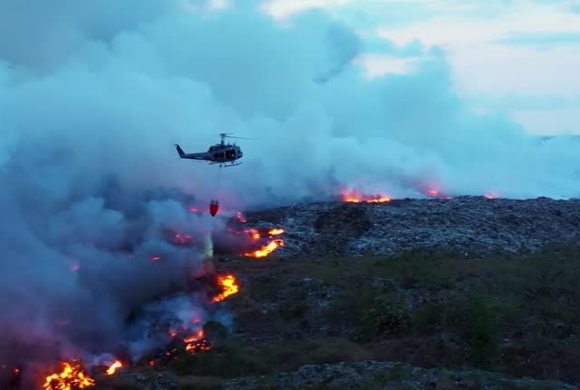
Indonesia is using several methods to keep the fires under control. Around 48,000 personnel have been deployed across six priority provinces, while 35 aircraft are available for monitoring, water bombing, and weather modification.
Central Kalimantan is one place where authorities are trying several approaches at once. On August 19, Forestry Minister Raja Juli Antoni inspected fires in the Petuk Katimpun area of Palangka Raya.
He said weather modification operations, known as OMC, could be an effective option if suitable clouds are available. The idea is fairly simple. If the right clouds are present, authorities can seed them in an attempt to produce rain over fire-affected areas.
But there’s an obvious limitation. You need clouds first. “If there are even small clouds that can technically be seeded, we will conduct OMC,” Raja Juli said.
Water-bombing helicopters are also being used, while teams on the ground include disaster officials, the military, police, Manggala Agni firefighters, and local communities.
But even with all those people and aircraft, one basic problem remains: water. Some fire locations don’t have enough accessible water. Officials are therefore considering more bore wells and other water sources to help teams reach fires more effectively.
Sources:
Leave a Reply