


Today, gold sounds like something that belongs in jewelry shops, bank vaults, or maybe a pirate movie. But in Aceh, you can find it in places where it really shouldn’t be, deep inside forests, along rivers, and on mountain slopes.
And the strange part? The government has already said these illegal mines need to stop. So why are excavators still moving?
Across Aceh, people say illegal gold mining is continuing even after government and law enforcement officials promised a crackdown. Heavy machines are still entering forest areas. Fuel and supplies are still being delivered.
In some places, residents even say diesel disappears from gas stations because so much of it is being used by mining equipment.
Behind those machines is a much bigger problem. Aceh’s forests are home to some of Indonesia’s most important wildlife, and illegal mining is leaving a growing scar on the landscape.
This is a story from Indonesia’s north-westmost region, Aceh.
The Crackdown

In late July, government, police, and law enforcement officials in Aceh held a major meeting about illegal gold mining. Their message was clear, stop mining and remove the heavy equipment by August 17, Indonesia’s Independence Day.
The government also reminded miners that using mercury and cyanide is prohibited. People involved in illegal mining could face prosecution under Indonesia’s forestry and mining laws.
On paper, it sounded like a serious crackdown. On the ground, however, things looked very different.
Residents in several districts told Mongabay Indonesia that mining was still happening in late August. Amran, a community leader in Seunagan, Nagan Raya, said excavators continued working around riverbanks. Fuel and other supplies were also still being transported into mining areas.
In South Aceh, a resident named Razali said diesel often runs out at local gas stations. He believes much of the fuel is being used by heavy equipment digging for gold along rivers and mountain slopes.
In Pidie district, residents also reported seeing the tarpaulin shelters used by miners still standing after the government deadline had passed.
For local people, this raises an obvious question. If everyone knows the mines are there, why are they still operating?
Hamdani, a resident of Tangse in Pidie, said an announcement alone would not change much because mining groups can be powerful enough to protect the areas where they work.
The Real Price
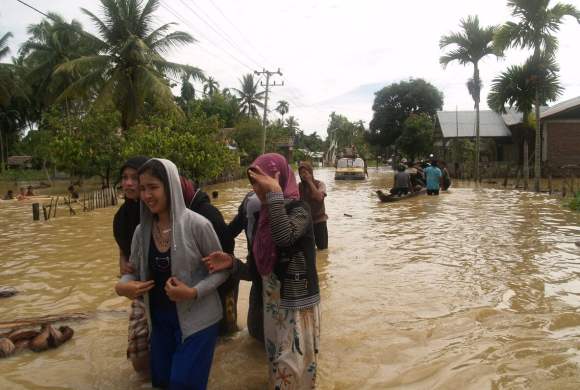
You might think illegal gold mining is mainly about people digging holes in the ground. Look closer, and you’ll see a much bigger mess.
According to Walhi, Indonesia’s largest environmental advocacy organization, illegal mining damaged about 23,433 hectares of forest in Aceh between 2023 and 2025. That is roughly four times the area of Banda Aceh.
Around 10,552 hectares of the damaged land were inside protected forests. The damage was especially serious around three major river systems, the Meureubo, Seunagan, and Woyla rivers. The Woyla system alone accounted for almost one-third of the total damage recorded by Walhi.
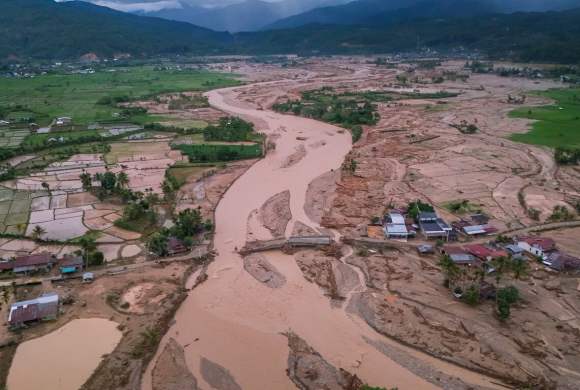
Mining changes the landscape in several ways. Roads have to be cut through forests so excavators can enter. Workers build camps. Dams are created to store water, while sluices are used to separate gold from crushed material. What starts as one mining site can quickly become a network of cleared land and damaged waterways.
Then there is the water itself.
Photos from Aceh show rivers becoming cloudy because of mining activity around their headwaters. When local ecosystems depend on those rivers, muddy water is not exactly a small side effect.
The chemicals used in gold processing create another problem. Mercury is used to bind with gold, while cyanide can help extract remaining gold particles. Both substances are dangerous and can cause serious health problems.
Indonesia has also committed to reducing mercury use through the Minamata Convention and its own national action plan. Illegal mining makes that goal harder to reach.
And the workers themselves are not safe either. Walhi has reported that dozens of miners have died in illegal mining operations in neighboring West Sumatra.
So the cost of gold is not simply measured by what someone pays for a piece of jewelry.
Orangutans Are Losing Ground
The province contains the Leuser Ecosystem, one of the most important tropical forest landscapes in Southeast Asia. It provides habitat for Sumatran elephants, orangutans, rhinos, sun bears, and tigers.
These animals are already under enormous pressure. When illegal mining moves deeper into the forest, it does not simply destroy trees. It also pushes wildlife into smaller and more disturbed spaces.
Mongabay recently reported that gold miners had entered a crucial forest area used for reintroducing Sumatran orangutans rescued from the illegal wildlife trade. These animals have already been through enough. The forest is supposed to be their safe place to return to.
Instead, mining is showing up at their doorstep. That makes the issue bigger than illegal workers and lost government revenue. It becomes a question of what kind of forest Aceh wants to keep.
Former Aceh provincial secretary M. Nasir said illegal mining creates several risks, including pollution, workplace accidents, social conflict, and lost revenue for the government.
Police chief Ruddi Setiawan has also called for stronger cooperation between institutions. That matters because illegal mining is not something one agency can easily solve alone.
You need police action, environmental enforcement, control of fuel supplies, financial investigations, and protection of forest areas. Otherwise, shutting down one mining site could simply push the operation somewhere else.
Following The Money?
Walhi director Ahmad Shalihin argues that authorities need to go after the people financing the mining operations, not only the workers operating the machines.
That could be the most important part of the whole story.
Walhi says more than 1,000 pieces of heavy equipment have been identified in forest areas, with more than 450 illegal mining operations across Aceh. That means a huge amount of machinery, fuel, supplies, and money is moving through these forests.
Someone is paying for all of it.
Ahmad has called on authorities to seize the heavy equipment, freeze the assets of financiers, and prosecute those behind the operations. He also argues that cutting off fuel supplies, stopping mercury distribution, disrupting illegal gold trading routes, and taking away excavators could seriously weaken the mining network.
In other words, you do not win this fight by chasing every excavator through the forest like a game of hide-and-seek. You have to find the people who keep the whole operation running.
Sources,
Leave a Reply